Welcome to Smartindia Student's Blogall posts
rose


| Rose | |
|---|---|
 | |
| Rosa rubiginosa | |
| Scientific classification | |
| Kingdom: | Plantae |
| (unranked): | Angiosperms |
| (unranked): | Eudicots |
| (unranked): | Rosids |
| Order: | Rosales |
| Family: | Rosaceae |
| Subfamily: | Rosoideae |
| Genus: | Rosa L. |
| Species | |
| Synonyms | |
A rose is a woody perennial of the genus Rosa, within the family Rosaceae. There are over 100 species. They form a group of plants that can be erect shrubs, climbing or trailing with stems that are often armed with sharp prickles. Flowers vary in size and shape and are usually large and showy, in colours ranging from white through yellows and reds. Most species are native to Asia, with smaller numbers native to Europe, North America, and northwest Africa. Species, cultivars and hybrids are all widely grown for their beauty and often are fragrant. Rose plants range in size from compact, miniature roses, to climbers that can reach 7 meters in height. Different species hybridize easily, and this has been used in the development of the wide range of garden roses.[1]
The name rose comes from French, itself from Latin rosa, which was perhaps borrowed from Oscan, from Greek ????? rhódon(Aeolic ?????? wródon), itself borrowed from Old Persian wrd- (wurdi), related to Avestan var??a, Sogdian ward, Parthian wâr.[2][3]
Contents[hide] |
Botany


The leaves are borne alternately on the stem. In most species they are 5 to 15 centimetres (2.0 to 5.9 in) long, pinnate, with (3–) 5–9 (–13) leaflets and basal stipules; the leaflets usually have a serrated margin, and often a few small prickles on the underside of the stem. Most roses are deciduous but a few (particularly from South eastAsia) are evergreen or nearly so.

The flowers of most species have five petals, with the exception of Rosa sericea, which usually has only four. Each petal is divided into two distinct lobes and is usually white or pink, though in a few species yellow or red. Beneath the petals are five sepals (or in the case of some Rosa sericea, four). These may be long enough to be visible when viewed from above and appear as green points alternating with the rounded petals. There are multiple superior ovaries that develop into achenes.[4] Roses are insect-pollinated in nature.
The aggregate fruit of the rose is a berry-like structure called a rose hip. Many of the domestic cultivars do not produce hips, as the flowers are so tightly petalled that they do not provide access for pollination. The hips of most species are red, but a few (e.g. Rosa pimpinellifolia) have dark purple to black hips. Each hip comprises an outer fleshy layer, the hypanthium, which contains 5–160 "seeds" (technically dry single-seeded fruits called achenes) embedded in a matrix of fine, but stiff, hairs. Rose hips of some species, especially the Dog Rose (Rosa canina) and Rugosa Rose (Rosa rugosa), are very rich in vitamin C, among the richest sources of any plant. The hips are eaten by fruit-eating birds such as thrushes and waxwings, which then disperse the seeds in their droppings. Some birds, particularlyfinches, also eat the seeds.

While the sharp objects along a rose stem are commonly called "thorns", they are technically prickles — outgrowths of the epidermis (the outer layer of tissue of the stem). (True thorns, as produced by e.g. Citrus or Pyracantha, are modified stems, which always originate at a node and which have nodes and internodes along the length of the thorn itself.) Rose prickles are typically sickle-shaped hooks, which aid the rose in hanging onto other vegetation when growing over it. Some species such as Rosa rugosa and Rosa pimpinellifolia have densely packed straight prickles, probably an adaptation to reduce browsing by animals, but also possibly an adaptation to trap wind-blown sand and so reduce erosion and protect their roots (both of these species grow naturally on coastal sand dunes). Despite the presence of prickles, roses are frequently browsed by deer. A few species of roses have only vestigial prickles that have no points.
Species
The genus Rosa is subdivided into four subgenera:
- Hulthemia (formerly Simplicifoliae, meaning "with single leaves") containing one or two species from southwest Asia, R. persicaand Rosa berberifolia which are the only roses without compound leaves or stipules.
- Hesperrhodos (from the Greek for "western rose") contains Rosa minutifolia and Rosa stellata, from North America.
- Platyrhodon (from the Greek for "flaky rose", referring to flaky bark) with one species from east Asia, Rosa roxburghii.
- Rosa (the type subgenus) containing all the other roses. This subgenus is subdivided into 11 sections.
- Banksianae - white and yellow flowered roses from China.
- Bracteatae - three species, two from China and one from India.
- Caninae - pink and white flowered species from Asia, Europe and North Africa.
- Carolinae - white, pink, and bright pink flowered species all from North America.
- Chinensis - white, pink, yellow, red and mixed-color roses from China and Burma.
- Gallicanae - pink to crimson and striped flowered roses from western Asia and Europe.
- Gymnocarpae - one species in western North America (Rosa gymnocarpa), others in east Asia.
- Laevigatae - a single white flowered species from China
- Pimpinellifoliae - white, pink, bright yellow, mauve and striped roses from Asia and Europe.
- Rosa (syn. sect. Cinnamomeae) - white, pink, lilac, mulberry and red roses from everywhere but North Africa.
- Synstylae - white, pink, and crimson flowered roses from all areas.

Uses
Roses are best known as ornamental plants grown for their flowers in the garden and sometimes indoors. They have been also used for commercial perfumery and commercial cut flower crops. Some are used as landscape plants, for hedging and for other utilitarian purposes such as game cover and slope stabilization. They also have minor medicinal uses.
Ornamental plants
The majority of ornamental roses are hybrids that were bred for their flowers. A few, mostly species roses are grown for attractive or scented foliage (such as Rosa glauca and Rosa rubiginosa), ornamental thorns (such as Rosa sericea) or for their showy fruit (such asRosa moyesii).

Ornamental roses have been cultivated for millennia, with the earliest known cultivation known to date from at least 500 BC in Mediterranean countries, Persia, and China.[5] Many thousands of rose hybrids and cultivars have been bred and selected for garden use as flowering plants. Most are double-flowered with many or all of the stamens having mutated into additional petals.
In the early 19th century the Empress Josephine of France patronized the development of rose breeding at her gardens at Malmaison. As long ago as 1840 a collection numbering over one thousand different cultivars, varieties and species was possible when a rosarium was planted byLoddiges nursery for Abney Park Cemetery, an early Victorian garden cemetery and arboretum in England.
A few species and hybrids are grown for non-floral ornamental use. Among these are those grown for prominent hips, such as the flagon shaped hips of Rosa moyesii. Sometimes even the thorns can be treated as an attraction or curiosity, such as with Rosa sericea.
Cut flowers

Roses are a popular crop for both domestic and commercial cut flowers. Generally they are harvested and cut when in bud, and held in refrigerated conditions until ready for display at their point of sale.
In temperate climates, cut roses are often grown in glasshouses, and in warmer countries they may also be grown under cover in order to ensure that the flowers are not damaged by weather and that pests and disease control can be carried out effectively. Significant quantities are grown in some tropical countries, and these are shipped by air to markets across the world.[6]
Perfume
Rose perfumes are made from attar of roses or rose oil, which is a mixture of volatile essential oils obtained by steam distilling the crushed petals of roses. An associated product is rose water which is used for cooking, cosmetics, medicine and in religious practices. The production technique originated in Persia then spread through Arabia and India, and more recently into eastern Europe. In Bulgaria, Iran and Germany, damask roses (Rosa damascena 'Trigintipetala') are used. In other parts of the world Rosa centifolia is commonly used. The oil is transparent pale yellow or yellow-grey in colour. 'Rose Absolute' is solvent-extracted with hexane and produces a darker oil, dark yellow to orange in colour. The weight of oil extracted is about one three-thousandth to one six-thousandth of the weight of the flowers; for example, about two thousand flowers are required to produce one gram of oil.

The main constituents of attar of roses are the fragrant alcohols geraniol and l-citronellol and rose camphor, an odorless solid composed of alkanes, which separates from rose oil.[7] ?-Damascenone is also a significant contributor to the scent.
Food and drink
Rose hips are occasionally made into jam, jelly, and marmalade, or are brewed for tea, primarily for their high vitamin C content. They are also pressed and filtered to make rose hip syrup. Rose hips are also used to produce Rose hip seed oil, which is used in skin products and some makeup products.[citation needed]

Rose petals or flower buds are sometimes used to flavour ordinary tea, or combined with other herbs to make tisanes.
In France there is much use of rose syrup, most commonly made from an extract of rose petals. In the United States, this French rose syrup is used to make rose scones and marshmallows.[citation needed]
Rose flowers are used as food, also usually as flavouring or to add their scent to food.[8] Other minor uses include candied rose petals.[9]
Rose creams (rose flavoured fondant covered in chocolate, often topped with a crystallised rose petal) are a traditional English confectionery widely available from numerous producers in the UK.[10][11]
Medicine
The rose hip, usually from R. canina is used as a minor source of Vitamin C. The fruits of many species have significant levels of vitamins and have been used as a food supplement. Many roses have been used in herbal and folk medicines. Rosa chinensis has long been used in Chinese traditional medicine. This and other species have been used for stomach problems, and are being investigated for controlling cancer growth.[12]
Culture
Art
Roses are a favored subject in art and appear in portraits, illustrations, on stamps, as ornaments or as architectural elements. The Luxembourg born Belgian artist and botanist Pierre-Joseph Redouté is known for his detailed watercolours of flowers, particularly roses.

Henri Fantin-Latour was also a prolific painter of still life, particularly flowers including roses. The Rose 'Fantin-Latour' was named after the artist.
Other impressionists including Claude Monet, Paul Cézanne and Pierre-Auguste Renoir have paintings of roses among their works.
Symbolism
The long cultural history of the rose has led to it being used often as a symbol.
Pests and diseases
Wild roses are host plants for a number of pests and diseases. Many of these are also shared with other plants, including especially other genera of the Rosaceae.
Cultivated roses are often subject to severe damage from insect, arachnid and fungal pests and diseases. In many cases they cannot be usefully grown without regular treatment to control these problems.
hibiscus
| Hibiscus rosa-sinensis | |
|---|---|
 | |
| Hibiscus rosa-sinensis 'Brilliant' | |
| Scientific classification | |
| Kingdom: | Plantae |
| (unranked): | Angiosperms |
| (unranked): | Eudicots |
| (unranked): | Rosids |
| Order: | Malvales |
| Family: | Malvaceae |
| Genus: | Hibiscus |
| Species: | H. rosa-sinensis |
| Binomial name | |
| Hibiscus rosa-sinensis L. | |
Hibiscus rosa-sinensis, known colloquially as rose mallow, Chinese hibiscus, China rose and shoe flower, is a species offlowering plant in the family Malvaceae, native to East Asia.


Contents[hide] |
Description [edit]
Hibiscus rosa-sinensis is a bushy, evergreen shrub or small tree growing 2.5–5 m (8–16 ft) tall and 1.5–3 m (5–10 ft) wide, with glossy leaves and solitary, brilliant red flowers in summer and autumn. The 5-petaled flowers are 10 cm (4 in) in diameter, with prominent orange-tipped red anthers.[1]
Cultivation [edit]
It is widely grown as an ornamental plant throughout the tropics and subtropics. As it does not tolerate temperatures below 10 °C(50 °F), in temperate regions it is best grown under glass. However, plants in containers may be placed outside during the summer months.[1]
Numerous varieties, cultivars, and hybrids are available, with flower colors ranging from white through yellow and orange to scarlet and shades of pink, with both single and double sets of petals. The cultivar 'Cooperi' has gained the Royal Horticultural Society'sAward of Garden Merit.[2]
Ecology [edit]
Despite its size and red hues, which are attractive to nectar-feeding birds[citation needed], it is not visited regularly by hummingbirdswhen grown in the Neotropics. Generalists, like the Sapphire-spangled Emerald, Amazilia lactea, or long-billed species, like theStripe-breasted Starthroat, Heliomaster squamosus, are occasionally seen to visit it, however.[3] In the subtropical and temperateAmericas, hummingbirds are regularly attracted to it.[why?]
.JPG)
Nomenclature [edit]
Hibiscus rosa-sinensis was named by Carolus Linnaeus. The Latin term rosa-sinensis literally means "rose of China", though it is not closely related to the true roses.[4] Is is usually known among the Chinese as zh? j?n ??, which literally means "vermilion hibiscus". It also has many other names in Chinese: fú s?ng ??, fó s?ng ??, chì j?n ??, s?ng j?n ??, rì jí ??, hu? shàng hu????, zhào diàn hóng ???, zhuàng yuán hóng ???, dà hóng hu? ???, and so on. It also has prominent presence in the various parts of the Indian subcontinent. It has several names in different languages: Jaswand in Marathi, Bengali: ??? (Jaba),Tamil: ??????????? (sembaruthi), Hindi: ??????, ??????, ??????, ???,[5] ??? ?????[6], Malayalam: ?????????? (cemparatti), Mondaroin Oriya, Wada Mal in Sinhala, Mamdaram in Telugu: ??????, Kembang Sepatu in Indonesia and Gumamela in Filipino.
National symbol [edit]

Hibiscus rosa-sinensis is the national flower of Malaysia, called Bunga Raya in Malay. Introduced into the Malay Peninsula in the 12th century, it was nominated as the national flower in the year 1958 by the Ministry of Agriculture amongst a few other flowers, namely ylang ylang, jasmine, lotus, rose, magnolia, and medlar. On 28 July 1960, it was declared by the government of Malaysia that the hibiscus would be the national flower.
The word bunga in Malay means "flower", while raya in Malay means "big" or "grand". The hibiscus is literally known as the "big flower" in Malay. The red of the petals symbolizes the courage, life, and rapid growth of the Malaysian, and the five petals represent the five Rukun Negara of Malaysia. The flower can be found imprinted on the notes and coins of the Malaysian ringgit.
Uses [edit]

rosa chinensis
| Rosa chinensis | |
|---|---|
 | |
| A double-flowered cultivar | |
| Scientific classification | |
| Kingdom: | Plantae |
| (unranked): | Angiosperms |
| (unranked): | Eudicots |
| (unranked): | Rosids |
| Order: | Rosales |
| Family: | Rosaceae |
| Genus: | Rosa |
| Species: | R. chinensis |
| Binomial name | |
| Rosa chinensis Jacq. | |
Rosa chinensis (Chinese name:??, pinyin: yueji), known commonly as the China Rose, is a member of the genus Rosa native toSouthwest China in Guizhou, Hubei, and Sichuan Provinces.
It is a shrub growing to 1–2 m tall. The leaves are pinnate, with 3-5 leaflets, each leaflet 2.5–6 cm long and 1–3 cm broad. In the wild species (sometimes listed as Rosa chinensis var. spontanea), the flowers have five pink to red petals. The fruit is a red hip 1–2 cm diameter.
Uses [edit]
The species is extensively cultivated in China as an ornamental plant; numerous cultivars have been selected, with varying flower colour and usually an increased number of petals (semi-double or double flowers). The species is also important in the breeding of many modern garden roses, including the Hybrid Tea roses.
The flowers and fruits are used in traditional Chinese medicine (TCM) in the treatment of irregular and/or painfulmenstruation,[citation needed] as well as swollen thyroid.[citation needed]
See also [edit]
References [edit]
 | Wikimedia Commons has media related to: Rosa chinensis |

caterpillar
[edit]

Caterpillars have been called "eating machines", and eat leaves voraciously. Most species shed their skin four or five times as their bodies grow, and they eventually pupate into an adult form.[11] Caterpillars grow very quickly; for instance, a tobacco hornworm will increase its weight ten-thousandfold in less than twenty days. An adaptation that enables them to eat so much is a mechanism in a specialized midgut that quickly transports ions to the lumen (midgut cavity), to keep the potassium level higher in the midgut cavity than in the blood.[12]

Most caterpillars are solely herbivorous. Many are restricted to one species of plant, while others are polyphagous. A few, including the clothes moth, feed on detritus. Most predatory caterpillars feed on eggs of other insects, aphids, scale insects, or ant larvae. Some are predatory, and others prey on caterpillars of other species (e.g. Hawai'ian Eupithecia). A few are parasitic on cicadas or leaf hoppers.[13] Some Hawai'ian caterpillars (Hyposmocoma molluscivora) use silk traps to capture snails.[14]
Many caterpillars are nocturnal. For example, the "cutworms" (of the Noctuidae family) hide at the base of plants during the day and only feed at night.[15] Others, such as gypsy moth (Lymantria dispar) larvae, change their activity patterns depending on density and larval stage, with more diurnal feeding in early instars and high densities.[16]
moth
| Moth | |
|---|---|
 | |
| Emperor Gum Moth, Opodiphthera eucalypti | |
| Scientific classification | |
| Kingdom: | Animalia |
| Phylum: | Arthropoda |
| Class: | Insecta |
| Order: | Lepidoptera |
| (unranked): | Heterocera |
butterfly
| Butterflies Temporal range: Eocene-Recent, 45–0Ma | |
|---|---|
 | |
| Charaxes brutus natalensis in Dar es Salaam,Tanzania | |
| Scientific classification | |
| Kingdom: | Animalia |
| Phylum: | Arthropoda |
| Class: | Insecta |
| Order: | Lepidoptera |
| Suborder: | Rhopalocera |
| Subgroups | |
| |
A butterfly is a mainly day-flying insect of the order Lepidoptera, which includes the butterflies and moths. Like other holometabolous insects, the
snow cat]

A snowcat is an enclosed-cab, truck-sized, fully tracked vehicle designed to move on snow. Snowcats are often referred to as 'trail groomers' (or 'piste bashers' in British English) because of their use for grooming ski trails ("pistes") or snowmobile trails. Most snowcats, such as the ones produced byBombardier or Aktiv in the past, have two sets of tracks, fitted with a Christie suspension or a Vickers suspension. Others, like the Tucker Sno-Cat andHägglunds vehicles, have a complex arrangement of four or more tracks.
The tracks are usually made of rubber, aluminum or steel and driven by a single sprocket on each side, and ride over rubber wheels with a solid foam interior. Their design is optimized for a snow surface, or soft grounds such as that of a peat bog. In addition to grooming snow they are used for polar expeditions, logging in marsh areas, leveling sugar beet piles, and seismic studies in the wild.
The cabs are optimized for use in sub-zero weather or cold conditions worsened by wind chill, with strong forced heating and a windshield designed to be kept clear of internal and external ice or condensation through a variety of means such as advanced coatings, external scrapers (windshield wipers of a modified type), and internal ducts blowing hot air on the surface.
Contents[hide] |
snow bear
| Tibetan blue bear | |
|---|---|
 | |
| U. a. pruinosus | |
| Conservation status | |
Scientific classification | |
| Kingdom: | Animalia |
| Phylum: | Chordata |
| Class: | Mammalia |
| Order: | Carnivora |
| Family: | Ursidae |
| Genus: | Ursus |
| Species: | U. arctos |
| Subspecies: | U. a. pruinosus |
| Trinomial name | |
| Ursus arctos pruinosus Blyth, 1854 | |
snow dog
 Promotional poster. | |
| Directed by | Brian Levant |
|---|---|
| Produced by | Casey Grant Jordan Kerner |
| Written by | Jim Kouf Tommy Swerdlow Michael Goldberg Mark Gibson Philip Halprin |
| Based on | Premise suggested byWinterdance: The Fine Madness of Running the Iditarod by Gary Paulsen |
| Starring | Cuba Gooding Jr. James Coburn Nichelle Nichols Joanna Bacalso Sisqó |
| Music by | John Debney |
| Cinematography | Thomas E. Ackerman |
| Editing by | Roger Bondelli |
| Studio | Kerner Entertainment |
| Distributed by | Walt Disney Pictures |
| Release date(s) |
|
| Running time | 101 minutes |
| Country | United States |
| Language | English |
| Budget | $33 million |
| Box office | $115,035,090 |
tailor bird
| Tailorbird | |
|---|---|
 | |
| Common Tailorbirds (Orthotomus sutorius) | |
| Scientific classification | |
| Kingdom: | Animalia |
| Phylum: | Chordata |
| Class: | Aves |
| Order: | Passeriformes |
| Family: | Cisticolidae |
| Genus: | Orthotomus Horsfield, 1821 |
| Species | |
See text | |
cheetah

| Cheetah[1] Temporal range: Late Pliocene to Recent | |
|---|---|
 | |
| Conservation status | |
| Scientific classification | |
| Kingdom: | Animalia |
| Phylum: | Chordata |
| Class: | Mammalia |
| Order: | Carnivora |
| Family: | Felidae |
| Genus: | Acinonyx |
| Species: | A. jubatus |
| Binomial name | |
| Acinonyx jubatus (Schreber, 1775) | |
| Type species | |
| Acinonyx venator Brookes, 1828 (= Felis jubata, Schreber, 1775) by monotypy | |
| Subspecies | |
See text. | |
 | |
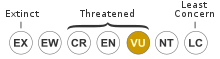
leopard
| ard | |
|---|---|
 | |
| Female Indian leopard from Bardia National Park, Nepal | |
| Conservation status | |
| Scientific classification | |
| Kingdom: | Animalia |
| Phylum: | Chordata |
| Class: | Mammalia |
| Order: | Carnivora |
| Family: | Felidae |
| Genus: | Panthera |
| Species: | P. pardus |
| Subspecies: | P. p. fusca |
| Trinomial name | |
| Panthera pardus fusca (Meyer), 1794 | |
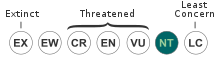
The Indian leopard (Panthera pardus fusca) is a leopard subspecies widely distributed on the Indian subcontinent and classified as Near Threatened