Welcome to Smartindia Student's Blogall posts

Google Inc. is an American multinational corporation specializing in Internet-related services and products. These include search, cloud computing, software and online advertising technologies.[6] Most of its profits derive from AdWords.[7][8]
Google was founded by Larry Page and Sergey Brin while they were Ph.D. students at Stanford University. Together they own about 16 percent of its stake. They incorporated Google as a privately held company on September 4, 1998. An initial public offering followed on August 19, 2004. Its mission statement from the outset was "to organize the world's information and make it universally accessible and useful",[9] and its unofficial slogan was "Don't be evil".[10][11] In 2006 Google moved to headquarters in Mountain View, California.
Rapid growth since incorporation has triggered a chain of products, acquisitions, and partnerships beyond Google's core search engine. It offers online productivity software including email, an office suite, and social networking. Desktop products include applications for web browsing, organizing and editing photos, and instant messaging. The company leads the development of the Android mobile operating system and the browser-only Google Chrome OS[12] for a specialized type of netbook known as a Chromebook. Google has moved increasingly into communications hardware: it partners with major electronics manufacturers in production of its high-end Nexus devices and acquired Motorola Mobility in May 2012.[13] In 2012, a fiber-optic infrastructure was installed in Kansas City to facilitate a Google Fiber broadband service.[14]The corporation has been estimated to run more than one million servers in data centers around the world[15] and to process over one billion search requests[16] and about twenty-four petabytes of user-generated data each day.[17][18][19][20] In December 2012 Alexa listed google.com as the most visited website in the world. Numerous Google sites in other languages figure in the top one hundred, as do several other Google-owned sites such as YouTube and Blogger.[21] Google ranks second in the BrandZ brand equity database.[22] Its market dominance has led to criticism over issues including copyright, censorship, and privacy
internet explorer
Internet Explorer, commonly abbreviated IE or MSIE) is a series of graphical web browsers developed by Microsoft and included as part of the Microsoft Windows line of operating systems, starting in 1995. It was first released as part of the add-on package Plus! for Windows 95 that year. Later versions were available as free downloads, or in service packs, and included in the OEM service releases of Windows 95 and later versions of Windows.
Internet Explorer is one of the most widely used web browsers, attaining a peak of about 95% usage share during 2002 and 2003.[4] Its usage share has since declined with the launch of Safari (2003), Firefox (2004), and Google Chrome (2008), each of which now has significant market share. Estimates for Internet Explorer's overall market share range from 27.4% to 54.13%, as of October 2012 (browser market share is notoriously difficult to calculate). Microsoft spent over US$100 million per year on Internet Explorer in the late 1990s,[5] with over 1000 people working on it by 1999.[6]
Since its first release, Microsoft has added features and technologies such as basic table display (in version 1.5); XMLHttpRequest (in version 5), which aids creation of dynamic web pages; and Internationalized Domain Names (in version 7), which allow Web sites to have native-language addresses with non-Latin characters. The browser has also received scrutiny throughout its development for use of third-party technology (such as the source code of Spyglass Mosaic, used without royalty in early versions) and security and privacy vulnerabilities, and both the United States and the European Union have alleged that integration of Internet Explorer with Windows has been to the detriment of other browsers.
The latest stable release is Internet Explorer 10, with a new interface allowing for use as both a desktop application, and as a Windows 8 application.
Versions of Internet Explorer for other operating systems have also been produced, including an Xbox 360 version called Internet Explorer for Xbox and an embedded OEM version called Pocket Internet Explorer, later rebranded Internet Explorer Mobile, which is currently based on Internet Explorer 9 and made for Windows Phone, Windows CE, and previously, based on Internet Explorer 7 for Windows Mobile. It remains in development alongside the desktop versions. Internet Explorer for Mac and Internet Explorer for UNIX (Solaris and HP-UX) have been discontinued.
CELL
ell is a microprocessor architecture that combines a general-purpose Power Architecture core of modest performance with streamlined coprocessing elements[1] which greatly accelerate multimedia and vector processing applications, as well as many other forms of dedicated computation.[1]
It was developed by Sony, Sony Computer Entertainment, Toshiba, and IBM, an alliance known as "STI". The architectural design and first implementation were carried out at the STI Design Center in Austin, Texas over a four-year period beginning March 2001 on a budget reported by Sony as approaching US$400 million.[2] Cell is shorthand for Cell Broadband Engine Architecture, commonly abbreviated CBEA in full or Cell BE in part.
The first major commercial application of Cell was in Sony's PlayStation 3 game console. Mercury Computer Systems has a dual Cell server, a dual Cell blade configuration, a rugged computer, and a PCI Express accelerator board available in different stages of production. Toshiba had announced plans to incorporate Cell in high definition television sets, but seems to have abandoned the idea. Exotic features such as the XDR memory subsystem and coherent Element Interconnect Bus (EIB) interconnect[3] appear to position Cell for future applications in the supercomputing space to exploit the Cell processor's prowess in floating point kernels.
The Cell architecture includes a memory coherence architecture that emphasizes efficiency/watt, prioritizes bandwidth over latency, and favors peak computational throughput over simplicity of program code. For these reasons, Cell is widely regarded as a challenging environment for software development.[4] IBM provides a comprehensive Linux-based Cell development platform to assist developers in confronting these challenges.[5] Software adoption remains a key issue in whether Cell ultimately delivers on its performance potential. Despite those challenges, research has indicated that Cell excels at several types of scientific computation.[6]
| Cell BE |
| software development |
| fabrication |
Contents |
ANGRY BIRDS
Angry Birds is a video game franchise created by Finnish computer game developer Rovio Entertainment. Inspired primarily by a sketch of stylized wingless birds, the first game was first released for Apple's iOS in December 2009.[2] Over 12 million copies of the game have been purchased from Apple's App Store,[3] which has prompted the company to design versions for other touchscreen-based smartphones, including the Android, Symbian and Windows Phone operating systems. It has since expanded to video game consoles and for PCs.
Angry Birds has been praised for its successful combination of addictive gameplay, comical style, and low price. Its popularity led to versions of Angry Birds being created for personal computers and gaming consoles, a market for merchandise featuring its characters and even long-term plans for a feature film or television series. With a combined 1.7 billion downloads across all platforms and including both regular and special editions,[4] the game has been called "one of the most mainstream games out right now",[5] "one of the great runaway hits of 2010",[6] and "the largest mobile app success the world has seen so far".[7]
Contents |
Game series

Angry Birds
The initial version of the game was released on iOS in December 2009. In the game, players use a slingshot to launch birds at pigs stationed on or within various structures, with the intent of destroying all the pigs on the playing field. As players advance through the game, new types of birds become available, some with special abilities that can be activated by the player. Rovio Mobile has supported Angry Birds with numerous free updates that add additional game content, and the company has also released stand-alone holiday and promotional versions of the game. There have been free upgrades released by Rovio:[8]
- "Poached Eggs"
- "Mighty Hoax"
- "Danger Above"
- "The Big Setup"
- "Ham 'Em High"
- "Mine and Dine"
- "Birdday Party"
- "Bad Piggies"
- "Surf and Turf"
- "Golden Eggs"
Special editions
Angry Birds Seasons
This game contains several holiday-themed episodes:
- "Trick or Treat": Halloween-themed levels
- "Season's Greedings": Christmas-themed levels
- "Hogs and Kisses": Valentine's Day-themed levels
- "Go Green, Get Lucky": St. Patrick's Day-themed levels
- "Easter Eggs": Easter-themed levels
- "Summer Pignic": Summer-themed levels
- "Mooncake Festival": Chinese Mid-Autumn Festival-themed levels
- "Ham'o'ween": Halloween-themed levels
- "Wreck the Halls": Christmas-themed levels
- "Year of the Dragon": Chinese New Year-themed levels
- "Cherry Blossom": Japanese-themed levels
- "Piglantis": Summer-themed levels
- "Back to School": School-themed levels
- "Haunted Hogs": Halloween-themed levels
- "Winter Wonderham": Christmas-themed levels
Angry Birds Rio
Angry Birds Rio was launched in March 2011.[9] The game is based on the 20th Century Fox animated film Rio.[9] There are several episodes included:
- "Smuggler's Den"
- "Jungle Escape"
- "Beach Volley"
- "Carnival Upheaval"
- "Airfield Chase"
- "Smuggler's Plane"
- "Golden Beachball"
- "Market Mayhem"
- "Trophy Room"
Angry Birds Space
A new game in the Angry Birds franchise called Angry Birds Space was launched on March 22, 2012,[10] The game features elements from the preceding Angry Birds games as well as new gameplay mechanics.[10] The stage is no longer flat, instead comprising several different planets, each of which has its own gravitational field that affects the trajectory of the birds after launch.[11] The episodes included are:
- "Pig Bang"
- "Cold Cuts"
- "Fry Me to the Moon"
- "Utopia"
- "Red Planet"
- "Pig Dipper"
- "Eggsteroids"
- "Danger Zone"
Angry Birds Star Wars
Angry Birds Star Wars was announced in October 8, 2012, and was released on November 8, 2012. Merchandise related to the game was released on October 17, and October 28. The game is a crossover with the Star Wars original trilogy, and casts the Angry Birds as the Rebels and the Bad Piggies as the Empire. The chapters included are:
- "Tatooine"
- "Death Star"
- "Hoth"
- "Cloud City"
- "Boba Fett Missions"
- "Path of the Jedi"
- "Bonus"
Spin-Off
A spin-off to Angry Birds, called Bad Piggies, was released on September 27, 2012 on Mac, Android and iOS platforms. The game is from the Pig's point of view, and involves building vehicles in order to reach a goal point.
Other media
The Angry Birds characters have been referenced in television programs throughout the world. The Israeli comedy show Eretz Nehederet (in English: a Wonderful Country), one of the nation's most popular TV programs, satirized recent failed Israeli-Palestinian peace attempts by featuring the Angry Birds in peace negotiations with the pigs. Clips of the segment went viral, getting viewers from all around the world. The sketch received favorable coverage from a variety of independent blogs such as digitaltrends.com,[5] hotair.com[12] and intomobile.com,[13] as well as from online news media agencies such as Haaretz,[14] The Christian Science Monitor,[6] The Guardian,[15] and MSNBC.[16] American television hosts Conan O'Brien, Jon Stewart and Daniel Tosh have referenced the game in comedy sketches on their respective series, Conan, The Daily Show, and Tosh.0.[17][18][19] In the 30 Rock episode "Plan B", guest star Aaron Sorkin laments to Liz Lemon, "Our craft is dying while people are playing Angry Birds and poking each other on Facebook". He then provides a tip for Liz to improve her score in the game. In February 2011, American journalist Jake Tapper mockingly introduced U.S. Senator Chris Coons as the "Angry Birds champion of the Senate" during the National Press Club's annual dinner.[20] Some of the game's more notable fans include Prime Minister David Cameron of the United Kingdom, who plays the iPad version of the game, and author Salman Rushdie, who claims he is "something of a master at Angry Birds".[21] Basketball star Kevin Durant is an avid fan of Angry Birds, and regularly plays other NBA stars in matches, although he is weary of cheating.[22] In August 2011, the Milwaukee Brewers played the Angry Birds theme song during the pre-game introductions of the arch-rival St. Louis Cardinals players, in reference to former Cardinals' manager Tony LaRussa's propensity to bean opposing players. Angry Birds also appears briefly, for comic relief, during a scene in the 2013 film G.I. Joe: Retaliation, in which the villain of the film plays the game while waiting for the world leaders' response to his threats of annihilation.

Angry Birds and its characters have been featured in advertisements for other products. In March 2011, the characters began appearing in a series of advertisements for Microsoft's Bing search engine.[23] At the 2011 South by Southwest festival in Austin, Texas, Nokia used scrims on a downtown building to project an advertisement for its new N8 handset that included the game's characters.[24] A June 2011 T-Mobile advertisement filmed in Barcelona, Spain included a real-life mock-up of the game in a city plaza,[25] while Nokia used the game in Kuala Lumpur, Malaysia to promote an attempt to set a world record for the largest number of people playing a single mobile game.[26] Finnair has also used Angry Birds in their advertising, including taping an Airbus A340 airliner with the Angry Birds figures and holding an Angry Birds tournament on board a flight to Singapore.[27] Rovio has also prepared a number of web-based promotional variants of Angry Birds themed around creations of other companies, such as Finnish snack company Fazer,[28] Spanish pizza delivery chain Telepizza,[29] and Japanese television network Fuji TV,[30] as well as promotions of American brands including Cheetos,[31] Wonderful Pistachios[32] and Coca-Cola.[33]
One of the 2012 New Models for Hot Wheels cars from Mattel is based on the Red Bird from Angry Birds. The package card bears both the Hot Wheels and Angry Birds logo.
The game's characters have been used, officially or otherwise, in amusement park attractions. In September 2011, the Window of the World theme park in Changsha, China opened an unlicensed Angry Birds attraction.[34] Visitors to the park use a large slingshot to launch stuffed versions of the bird characters at green balloons representing the pigs.[34] Upon learning of the attraction, Rovio Mobile was reported to be considering working with the theme park to officially license it.[35] In March 2012, Rovio announced plans for an official Angry Birds land (opened April 28, 2012) at the Särkänniemi adventure park in Finland.[36]
Also in March 2012, Formula 1 driver Heikki Kovalainen unveiled an Angry Birds crash helmet that he will use in the 2012 season, following sponsorship from Rovio. Kimi Räikkönen has also a Angry Birds Space logo on his cap. Angry Birds has teamed up with the Lotus F1 Team for the upcoming 2012 Monaco Grand Prix, with its logo on the top of each Lotus Renault F1 car's nosecone,[37] as well as a promotional web-based version of Angry Birds in honor of Kovalainen.[38]
HockeyBird, an angry hockey playing bird, was the official mascot of the 2012 IIHF Ice Hockey World Championships. It was designed by Toni Kysenius and Rovio Entertainment.[39]

The game's popularity has spawned knock-off and parody games that utilize the same basic mechanics as Angry Birds. For example, Angry Turds features monkeys hurling feces and other objects at hunters who have stolen their babies.[40] Another game, entitled Chicks'n'Vixens and released in beta form on Windows Phone devices, replaces the birds and pigs with chickens and foxes, respectively.[41] The developer of Chicks'n'Vixens intended the game as a challenge to Rovio Mobile, which stated at the time that a Windows Phone port of Angry Birds would not be ready until later in 2011.[41]
Angry Birds has inspired works of religious analogy. A five-part essay entitled "Angry Birds™ Yoga – How to Eliminate the Green Pigs in Your Life" was written by Giridhari Dasa of the International Society for Krishna Consciousness (i.e. Hare Krishna) of Brazil, utilizing the characters and gameplay mechanics to explain various concepts of yoga in Gaudiya Vaishnavism as understood and interpreted by the Hare Krishna.[42][43][44][45][46] The piece attracted much media attention, in Brazil and abroad, for its unique method of philosophico-religious presentation.[47][48][49][50] The piece was also recognized and appreciated by Rovio Mobile's Peter Vesterbacka, who was prompted to comment on Twitter, "Very cool! I can see Angry Birds Yoga becoming a worldwide craze;-)".[42]
Rovio is investigating ways to expand the Angry Birds brand, including merchandise, television shows and movies.[51] The game's official website offers plush versions of the birds and pigs for sale, along with T-shirts featuring the game's logo and characters.[52] In May 2011, Mattel released an Angry Birds board game, entitled "Angry Birds: Knock on Wood".[53] Over 10 million Angry Birds toys have been sold thus far.[54] Rovio opened the first official Angry Birds retail store in Helsinki on November 11, 2011 at 11:11am local time.[35] It expects to open its next retail store somewhere in China, considered the game's fastest-growing market.[35]
Mikael Hed, CEO of Rovio Mobile, has envisioned a feature film in the stop-motion animation style of Aardman Animation.[51] To that end, Rovio has purchased a Helsinki-based animation studio to prepare Angry Birds short cartoons on the Nicktoons station's Nickelodeon Extra,[54] the first of which was a Christmas special named "Wreck the Halls" that debuted in December 2011.[55] Rovio also hired David Maisel, former executive producer of Marvel Studios films such as Iron Man and Thor, to head up production of feature-length films.[54] Hed acknowledges that such a film would be years away, and that Rovio must keep the characters relevant until then, by producing sequels or new ports of the original game.[51] Rovio officials have hinted that one such "sequel" will be told from the pigs' point of view.[56]
On March 20, 2012, National Geographic published a paperback book titled Angry Birds Space: A Furious Flight Into The Final Frontier[57][58] shortly before the release of Angry Birds Space which became available on March 22, 2012.
At Spring 2012, Olvi started to manufacture Angry Birds softdrink, when It made a deal with Rovio for making of them.[59] First there came two different tastes, Tropic (tropical fruits).[59] and Paradise (pineapple-mandarin).[59] At September 2012 Olvi released two new tastes to the softdrink collection, they were Lagoon (pear-apple) and Space Comet (orange-cola).[60][61]
Angry Birds Toons, a TV series based on the game will make its debut on March 16, 2013. Initially it will consist of 52 episodes, with a duration between two and a half and three minutes each. Toons will be released through third-party video distribution platforms, including Comcast’s Xfinity On-Demand in the US, Samsung Smart TVs, and Roku set-top boxes. It will also be available in a number of countries on traditional television broadcasts. Rovio will also be bringing Angry Birds Toons on the mobile devices by adding an additional Toons channel on the Angry Birds apps homescreen.[62]
A 3D computer-animated film has been officially announced for release in 2016.[63]
See also


References
- ^ Promotional trailer
- ^ "Angry Birds Review". IGN.com. February 11, 2010. Retrieved March 24, 2011.
- ^ "The Supremely Addicting Angry Birds Hits 42 Million Free and Paid Downloads". SymbianFreak.com. October 22, 2010. Archived from the original on December 18, 2010. Retrieved December 11, 2010.
- ^ John Gaudiosi (March 11, 2012). "Rovio Execs Explain What Angry Birds Toons Channel Opens Up To Its 1.7 Billion Gamers". Forbes.com. Forbes.com LLC. Retrieved March 12, 2012.
- ^ a b Van Camp, Jeffrey (November 23, 2010). "Israeli Angry Birds satire goes viral". digitaltrends.com. Retrieved November 26, 2010.
- ^ a b Shaer, Matthew (November 29, 2010). "Angry Birds bound for Xbox, PlayStation". Archived from the original on December 04 2010. Retrieved November 29, 2010.
- ^ "Angry Birds will be bigger than Mickey Mouse and Mario. Is there a success formula for apps?". MIT Entrepreneurship review. February 18, 2011. Retrieved March 27, 2011.
- ^ "iOS Angry Birds Mighty Eagle On Its Way: Video". phonesreview.co.uk. November 25, 2010. Archived from the original on January 02 2011. Retrieved November 30, 2010.
- ^ a b Paul Suarez (January 29, 2011). "'Angry Birds Rio' Release Teams With Hollywood". PCWorld.com. Archived from the original on February 05 2011. Retrieved February 4, 2011.
- ^ a b Jeff Bertolucci (February 17, 2012). "Angry Birds in Space: The Final Merchandising Frontier?". PCWorld.com. Retrieved February 18, 2012.
- ^ "First Angry Birds Space Gameplay Footage Debuts from Orbit". Kotaku. March 8, 2012. Retrieved March 8, 2012.
- ^ "Breakthrough: Peace talks begin to settle bitter longstanding conflict". hotair.com. November 25, 2010. Archived from the original on November 28, 2010. Retrieved November 26, 2010.
- ^ "The Angry Birds Peace Treaty didn’t turn out so well". intomobile.com. November 23, 2010. Retrieved November 26, 2010.
- ^ "Israeli satire show goes viral with Angry Bird take on peace talks". Haaretz. November 22, 2010. Archived from the original on November 24, 2010. Retrieved November 26, 2010.
- ^ Stewart, Keith (November 23, 2010). "Angry Birds Treaty brings casual gaming into the world of satire". The Guardian (UK). Archived from the original on November 25, 2010. Retrieved November 29, 2010.
- ^ Popkin, Helen A.S. (November 22, 2010). "'Angry Birds' fail to negotiate peace treaty". MSNBC. Retrieved November 29, 2010.
- ^ Conan O'Brien (host) (December 15, 2010) (in English). Conan's Message to Finland (Television production). TBS. Event occurs at 1:38. Archived from the original on December 28, 2010. Retrieved December 21, 2010.
- ^ Jon Stewart (host) (February 16, 2011). Intro – Watson Competes on Jeopardy (Television production).
- ^ Daniel Tosh (January 11, 2011). Tosh.0: Angry Birds (Television production).
- ^ Mirkinson, Jack (February 10, 2011). "Chris Coons Mocks Jake Tapper". Huffington Post (USA). Retrieved February 17, 2011.
- ^ Nick Wingfield (November 30, 2010). "Why We Can't Stop Playing". The Wall Street Journal (Dow Jones & Company, Inc.). Retrieved March 27, 2011.
- ^ Kevin Durant @KDThunderup. "Man they be cheatin terrible on angry birds...make me wanna throw my phone out the window.". celebritytweet.com. Retrieved May 6, 2012.
- ^ Angry Birds Bing Video – Episode 1. Rovio Mobile. Retrieved March 7, 2011.
- ^ Angry Birds On A 15 Storey Building At SXSW. March 12, 2011. Retrieved June 9, 2011.
- ^ T-Mobile Angry Birds Live. Retrieved June 9, 2011.
- ^ Lim Yung Hui (June 11, 2011). "Guinness World Record at Nokia World’s Biggest Angry Birds Playground in Kuala Lumpur". greyreview.com. Retrieved December 14, 2011.
- ^ Matt Molnar (September 21, 2011). "Angry Birds Take Over Finnair Flight to Singapore - NYCAviation". Retrieved January 22, 2012.
- ^ Angry Birds Volcano
- ^ Angry Birds ?elepizza
- ^ Angry Birds Fujitv
- ^ Angry Birds Cheetos
- ^ Angry Birds Pistachios
- ^ Angry Birds Coca-Cola
- ^ a b Charles Cooper (September 16, 2011). "China steals "Angry Birds" for theme park". CBS News. Retrieved November 12, 2011.
- ^ a b c "Angry Birds Opens First Store". Yahoo.com. November 11, 2011. Retrieved November 12, 2011.
- ^ Updated 12:57 2 Mar 2012 by Andrew Wooden (2012-03-02). "Angry Birds Land to hit theme park in Finland". T3. Retrieved 2012-04-24.
- ^ Watch Out ! The Birds Have Landed ! 'Lotus F1 Team Angry Birds' Game Goes Live !. Lotus F1 Team (2012-05-23). Retrieved on 2012-09-05.
- ^ Angry Birds Heikki
- ^ "Born: Hockey Bird!". Iihf.com. Retrieved 2012-05-22.
- ^ Marc Flores (January 31, 2011). "Bored with Angry Birds? Try Angry Turds". IntoMobile.com. Retrieved February 5, 2011.
- ^ a b Chris Davies (February 2, 2011). "Chicks’n'Vixens brings Angry Birds clone to WP7 as Rovio protest". Slashgear.com. Retrieved February 5, 2011.
- ^ a b "Angry Birds™ Yoga – How to Eliminate the Green Pigs in Your Life, Part I". Giridhari Dasa. Retrieved June 26, 2011.
- ^ "Angry Birds™ Yoga – How to Eliminate the Green Pigs in Your Life, Part II". Giridhari Dasa. Retrieved June 26, 2011.
- ^ "Angry Birds™ Yoga – How to Eliminate the Green Pigs in Your Life, Part III". Giridhari Dasa. Retrieved June 26, 2011.
- ^ "Angry Birds™ Yoga – How to Eliminate the Green Pigs in Your Life, Part IV". Giridhari Dasa. Retrieved June 26, 2011.
- ^ "Angry Birds™ Yoga – How to Eliminate the Green Pigs in Your Life, Final Part". Giridhari Dasa. Retrieved June 26, 2011.
- ^ Kendall, Paul (February 7, 2011). "Angry Birds: the story behind iPhone's gaming phenomenon". London: telegraph.co.uk. Archived from the original on July 26, 2011. Retrieved June 26, 2011.
- ^ Name (required) (2011-06-15). "Angry Birds Yoga Making a Splash in Brazil | Giridhari’s Blog". Pandavas.wordpress.com. Retrieved 2012-02-01.
- ^ "topics". Dzai.com.br. Retrieved 2012-02-01.
- ^ Smullen, Madhava (June 25, 2011). "Is ISKCON Devotee's "Angry Birds Yoga" Set To Go Viral?". news.iskcon.com. Retrieved June 26, 2011.
- ^ a b c Marc Graser (August 24, 2010). "Angry Birds flies with Hollywood". Variety. Archived from the original on October 28, 2010. Retrieved November 29, 2010.
- ^ "Angry Birds Shop". Rovio.com. Archived from the original on December 09 2010. Retrieved November 30, 2010.
- ^ Brian Stetler (January 7, 2011). "Angry Birds at C.E.S.". New York Times. Retrieved January 8, 2011.
- ^ a b c "Angry Birds Aim For World Domination". FoxNews.com. 2011-10-19. Retrieved 2011-10-20.
- ^ Eric Goldman (December 16, 2011). "Angry Birds Short Film Airing on Nicktoons". IGN.com. Retrieved December 19, 2011.
- ^ Bosker, Bianca (November 17, 2010). "Angry Birds sequel will reveal pigs' point of view". Huffington Post (USA). Retrieved January 6, 2011.
- ^ Nathan Brown (19). "National Geographic publishing Angry Birds book". Edge. Future Publishing Limited. Retrieved 26 July 2012.
- ^ Victoria Jaggard (8). ""Angry Birds Space" Q&A: Your Guide to the Angry Universe". National Geographic News. National Geographic Society. Retrieved 26 July 2012.
- ^ a b c ""Olvi pistää Angry Birdsit tölkkiin" (Finnish)[[Category:Articles with Finnish language external links]]". 9. Wikilink embedded in URL title (help)
- ^ ""Angry Birds Lagoon" (Finnish)[[Category:Articles with Finnish language external links]]". 9. Wikilink embedded in URL title (help)
- ^ ""Angry Birds Space Comet" (Finnish)[[Category:Articles with Finnish language external links]]". 9. Wikilink embedded in URL title (help)
- ^ Cite error: Invalid
<ref>tag; no text was provided for refs namedForbes-1.7B(see the help page). - ^ "John Cohen to Produce Angry Birds Movie for 2016". ComingSoon.net. December 11, 2012. Retrieved December 11, 2012.
External links
|
|||||||||||||

TROUBLE GAS
- lasma is any gas that has had some of its atom s or molecule s ... higher temperatures, to the point where other matter has trouble passing through. ...7 KB (1,097 words) - 19:07, 13 March 2013
- 44 | Trouble in the Works (Paired with The Revisionist Gas and Trouble in the Works as a triple feature titled The Big Sandwich) | ...28 KB (3,999 words) - 18:58, 17 May 2013
- British Army (section The Troubles)warfare dominated strategy on the Western Front , and the use of chemical and poison gases added to the devastation ... The Troubles: Operation Banner ...88 KB (11,616 words) - 12:00, 16 May 2013
- Belfast (section The Troubles)The Troubles ... situated near Carrickfergus . Phoenix Natural Gas Ltd. has been granted the licence for the transportation of natural gas ...131 KB (18,343 words) - 20:42, 15 May 2013
- school, and treat 400 high school-aged boys from troubled backgrounds. locomotive engines, carriages, gas engines, foundry products, and motor trucks. ...9 KB (1,038 words) - 19:44, 9 May 2013
- 2013, Gas Powered Games announced the Kickstarter project "Wildman ... com/5977246/were-hearing-about-layoffs-big-trouble-at-gas-powered-games- ...9 KB (1,127 words) - 10:49, 11 May 2013
- are not able to generate stars because their density of gas is too high. ... Originally, these galaxies had trouble creating stars because of ...12 KB (1,734 words) - 01:15, 30 April 2013
- Bullrun (section Car troubles)Car troubles ... They lost more time drilling a hole in the side of the gas tank to drain the watery gas, and still more time stopping to ...39 KB (6,579 words) - 22:32, 10 February 2013
- stealing money from the gas meter of a neighbor (an act he later tended to gloss over – describing it as "some minor trouble"), he was sent ...6 KB (868 words) - 19:38, 9 October 2012
- The Russia–Ukraine gas dispute of 2009 was a pricing dispute between Russia and ... and said it was having trouble making payments on time ...67 KB (9,247 words) - 09:29, 12 May 2013
- Corner Gas is a Canadian television sitcom created by Brent Butt . ... having been preceded by The Trouble with Tracy , Snow Job , Excuse My ...71 KB (10,755 words) - 17:48, 20 April 2013
- Shah Deniz gas field is the largest natural gas field in Azerbaijan . ... news | title More trouble for BP as gas scheme is halted | publisher ...5 KB (719 words) - 11:42, 17 May 2013
- Gas Huffer was an American garage rock band from Washington state. ... At the conclusion of Girl Trouble's set, K.P. Kendall called Gas ...5 KB (629 words) - 18:39, 13 March 2013
- A trouble light, also known as a rough service light or inspection lamp, is a ... prevent ignition of flammable gas around the lamp, such as ...2 KB (356 words) - 08:45, 6 March 2013
- Although the mine had been troubled with gas the fireboss had reported it clear at 6 a. m. on the day of the explosion. 1895 explosion ...4 KB (738 words) - 16:35, 21 March 2013
- arrest of its leaders for instigating the sarin gas attack on the Tokyo subway in 1995. a troubled 28 year-old who had severed all family ...2 KB (216 words) - 23:57, 14 September 2012
- In refrigeration , flash-gas is refrigerant in gas form produced spontaneously when ... References : com/trouble. htm HVAC Inormation - ...11 KB (1,536 words) - 10:40, 14 May 2013
- discovered an undersea natural gas field in the East China Sea, ... Story_ID 4489650 Oil and gas in troubled waters The Economist. ...13 KB (1,975 words) - 00:40, 8 April 2013
- The history of manufactured gas, important for lighting, heating, and cooking ... Where troubles with naphthalene developed, as it ...75 KB (11,690 words) - 18:46, 15 April 2013
Mail, or post, is a system for transporting letters and other tangible objects: written documents, typically enclosed in envelopes, and also small packages are delivered to destinations around the world. Anything sent through the postal system is called mail or post.[1]
A postal service can be private or public, though many governments place restrictions on private systems. Since the mid-19th century national postal systems have generally been established as government monopolies with a fee on the article prepaid. Proof of payment is often in the form of adhesive postage stamps, but postage meters are also used for bulk mailing.
Postal authorities often have functions other than transporting letters. In some countries, a Postal Telegraph and Telephone (PTT) service oversees the postal system as well as having authority over telephone and telegraph systems. Some countries' postal systems allow for savings accounts and handle applications for passports.
Contents |
Early postal systems

The practice of communication by written documents carried by an intermediary from one person or place to another almost certainly dates back nearly to the invention of writing. However, development of formal postal systems occurred much later. The first documented use of an organized courier service for the diffusion of written documents is in Egypt, where Pharaohs used couriers for the diffusion of their decrees in the territory of the State (2400 BC).
Persia
The first credible claim for the development of a real postal system comes from Ancient Persia, but the point of invention remains in question. The best documented claim (Xenophon) attributes the invention to the Persian King Cyrus the Great (550 BC),[2] while other writers credit his successor Darius I of Persia (521 BC). Other sources claim much earlier dates for an Assyrian postal system, with credit given to Hammurabi (1700 BC) and Sargon II (722 BC). Mail may not have been the primary mission of this postal service, however. The role of the system as an intelligence gathering apparatus is well documented, and the service was (later) called angariae, a term that in time came to indicate a tax system. The Old Testament (Esther, VIII) makes mention of this system: Ahasuerus, king of Medes, used couriers for communicating his decisions.
The Persian system worked on stations (called Chapar-Khaneh), where the message carrier (called Chapar) would ride to the next post, whereupon he would swap his horse with a fresh one, for maximum performance and delivery speed. Herodotus described the system in this way: "It is said that as many days as there are in the whole journey, so many are the men and horses that stand along the road, each horse and man at the interval of a day's journey; and these are stayed neither by snow nor rain nor heat nor darkness from accomplishing their appointed course with all speed".[3]
India

The economic growth and political stability under the Mauryan empire (322–185 BC) saw the development of impressive civil infrastructure in ancient India. The Mauryans developed early Indian mail service as well as public wells, rest houses, and other facilities for the common public.[5] Common chariots called Dagana were sometimes used as mail chariots in ancient India.[6]
In ancient times the kings, emperors, rulers, zamindars or the feudal lords protected their land through the intelligence services of specially trained police or military agencies and courier services to convey and obtain information through runners, messengers and even through pigeons. The chief of the secret service, known as the postmaster, maintained the lines of communication. . . . The people used to send letters to [their] distant relatives through their friends or neighbors.[7]

In South India, the Wodeyar dynasty (1399—1947) of the Kingdom of Mysore used mail service for espionage purposes thereby acquiring knowledge related to matters that took place at great distances.[8]
By the end of the 18th century the postal system in India had reached impressive levels of efficiency. According to British national Thomas Broughton, the Maharaja of Jodhpur sent daily offerings of fresh flowers from his capital to Nathadvara (a distance of 320 km), and they arrived in time for the first religious Darshan at sunrise.[9] Later this system underwent complete modernization when the British Raj established its full control over India. The Post Office Act XVII of 1837 provided that the Governor-General of India in Council had the exclusive right of conveying letters by post for hire within the territories of the East India Company. The mails were available to certain officials without charge, which became
NIMBUZZ
Skype (pron.: /?ska?p/) is a proprietary Voice over IP service and software application.
Skype was first released in 2003 written by Estonian developers Ahti Heinla, Priit Kasesalu, and Jaan Tallinn, Danish Janus Friis, and Swedish Niklas Zennström, who had also originally developed Kazaa.[12] It developed into a platform with over 600 million users and was bought by Microsoft in 2011 for $8.5 billion.[13]
The service allows users to communicate with peers by voice using a microphone, video by using a webcam, and instant messaging over the Internet. Phone calls may be placed to recipients on the traditional telephone networks. Calls to other users within the Skype service are free of charge, while calls to landline telephones and mobile phones are charged via a debit-based user account system. Skype has also become popular for its additional features, including file transfer, and videoconferencing. Competitors include SIP and H.323-based services, such as Linphone[14] and Google Voice.
Skype has 663 million registered users as of the end of 2010.[15] The network is operated by Microsoft, which has its Skype division headquarters in Luxembourg. Most of the development team and 44% of the overall employees of the division are situated in Tallinn and Tartu, Estonia.[16][17]
Unlike most other VoIP services, Skype is a hybrid peer-to-peer and client–server system. It makes use of background processing on computers running Skype software. Skype's original proposed name (Sky Peer-to-Peer) reflects this fact.
Some network administrators have banned Skype on corporate, government, home, and education networks,[18] citing reasons such as inappropriate usage of resources, excessive bandwidth usage, and security concerns.[19]
On January 9, 2013, Microsoft revealed that it intends to retire Windows Live Messenger in favor of its Skype service, although Messenger will continue in mainland China.[20] Microsoft transitioned all users in April 2013.[21]
Contents |
History
Skype was founded in 2003 by Janus Friis from Denmark and Niklas Zennström from Sweden.[22] The Skype software was developed by the Estonians Ahti Heinla, Priit Kasesalu, and Jaan Tallinn, who together with Friis and Zennström were also behind the peer-to-peer file sharing software Kazaa.[23] In August 2003, the first public beta version was released.
eBay acquisition
On 12 September 2005, eBay Inc. agreed to acquire Luxembourg-based Skype Technologies SA for approximately US$2.5 billion in up-front cash and eBay stock, plus potential performance-based consideration.[24]
Silver Lake, Andreessen Horowitz and the Canada Pension Plan Investment Board acquisition
On 1 September 2009, it was announced that eBay was selling 65% of Skype for US$1.9 billion, valuing Skype at US$2.75 billion.
Microsoft acquisition
On 10 May 2011, Microsoft Corporation acquired Skype Communications, S.à r.l for US$8.5 billion.[25] The company was incorporated as a division of Microsoft, and Microsoft acquired all of the company's technologies with the purchase. This was completed on 13 October 2011.[25][26]
Windows Live Messenger merger
Microsoft phased out its long-standing Windows Live Messenger instant messaging service in favour of Skype.[20] Microsoft began this transition in April 8, 2013, and completed the move by Ap
MUSIC
Music (Carole King album), a 1972 album by Carole King Music (311 album), a 1993 album by 311 Music (Madonna album), a 2000 album by Madonna Music (Erick Sermon album), a 2001 album by Erick Sermon Music (Mika Nakashima album), a 2005 album by Mika Nakashima Music (Girugamesh album), a 2008 album Songs "Music", a Petula Clark song from the 1965 album Downtown "Music (John Miles song)", a 1976 single by John Miles from the album Rebel "Music" (Madonna song), a 2000 single from Madonna's album Music "Music" (Erick Sermon and Marvin Gaye song), a
SCIENCE
S.C.I.E.N.C.E. is the second album by American rock band Incubus, released on September 9, 1997. The album was certified Gold by the RIAA. It has been mentioned[where?] by lead singer Brandon Boyd that the acronym S.C.I.E.N.C.E. stands for Sailing Catamarans Is Every Nautical Captain's Ecstasy.[citation needed]
Contents |
Music
S.C.I.E.N.C.E. draws influence from diverse genres, including heavy metal,[1][2] electro,[3] funk,[1][2] jazz,[2][3] hip hop[1] and techno.[1] According to Rolling Stone writer Rob Kemp, S.C.I.E.N.C.E. "links funk metal to the rap metal".[4] "Magic Medicine" incorporates elements of trip hop, sampling a recorded reading of a children's book.[5] The song "Vitamin" appears in the film Final Destination 2. Also, the song "Segue 1" is an instrumental hidden track at the end of "Calgone".
Reception
| Professional ratings | |
|---|---|
| Review scores | |
| Source | Rating |
| Allmusic |   [6] [6] |
| Drop-D Magazine | (favorable)[5] |
| Martin Charles Strong |   [7] [7] |
Critics praised the album's diversity of styles. Pitchfork Media wrote that Incubus "successfully combines all sorts of [music genres] without sounding like a mess".[3] Allmusic reviewer David Thomas wrote that "The numerous styles on the album don't always blend perfectly, but they create a solid sound that defines the band. Incubus also manages to make their songs upbeat and danceable as well as tunes to headbang to. An admirable feat in a genre that tends to reward decibel levels instead of quality."[6] Drop-D Magazine reviewer Darren Kerr praised the album for its originality.[5] In The New Rolling Stone Album Guide, Kemp gave the album two out of five stars.[4] In The Great Rock Discography, Martin Charles Strong gave the album six out of ten stars.[7]
Track listing
All songs written and composed by Incubus.
| No. | Title | Length | |
|---|---|---|---|
| 1. | "Redefine" | 3:22 | |
| 2. | "Vitamin" | 3:13 | |
| 3. | "New Skin" | 3:51 | |
| 4. | "Idiot Box" | 4:07 | |
| 5. | "Glass" | 3:37 | |
| 6. | "Magic Medicine" | 3:03 | |
| 7. | "A Certain Shade of Green" | 3:11 | |
| 8. | "Favorite Things" | 3:11 | |
| 9. | "Summer Romance (Anti-Gravity Love Song)" | 4:26 | |
| 10. | "Nebula" | 3:50 | |
| 11. | "Deep Inside" | 3:55 | |
| 12. | "Calgone" | 16:05 | |
|
Total length:
|
55:52 | ||
References
- ^ a b c d Friedlander, Paul (2006). "We Should Be Together". Rock & roll: A Social History. Basic Books. p. 305. ISBN 0-8133-4306-2.
- ^ a b c Sullivan, Kate (November 2001). "The Accidental Sex Symbol". Spin 17 (11): 78.
- ^ a b c Wisdom, James. "Incubus: S.C.I.E.N.C.E.: Pitchfork Review". Pitchfork Media. Archived from the original on 5. Retrieved 20 November 2010. Text "February 2003" ignored (help)
- ^ a b Kemp, Rob (2004). "Incubus". In Brackett, Nathan; Hoard, Christian. The New Rolling Stone Album Guide (4th ed.). Simon and Schuste. p. 403. ISBN 0-7432-0169-8.
- ^ a b c Kerr, Darren (April 11, 1998). "Review of S.C.I.E.N.C.E.". Drop-D Magazine.
- ^ a b Thomas, David. "Review of S.C.I.E.N.C.E.". Allmusic. Retrieved 28 February 2010.
- ^ a b Strong, Martin Charles (2004). "Incubus". The Great Rock Discography (7th ed.). Canongate. p. 731. ISBN 1-84195-615-5.
|
|||||||||||||||||||||||||||||


MATHEMATICS
Mathematics (from Greek ?????? máth?ma, "knowledge, study, learning") is the abstract study of topics encompassing quantity,[2] structure,[3] space,[2] change,[4][5] and other properties;[6] it has no generally accepted definition.[7][8] Mathematicians seek out patterns[9][10] and formulate new conjectures. Mathematicians resolve the truth or falsity of conjectures by mathematical proof. When mathematical structures are good models of real phenomena, then mathematical reasoning can provide insight or predictions about nature. Through the use of abstraction and logical reasoning, mathematics developed from counting, calculation, measurement, and the systematic study of the shapes and motions of physical objects. Practical mathematics has been a human activity for as far back as written records exist. The research required to solve mathematical problems can take years or even centuries of sustained inquiry. Rigorous arguments first appeared in Greek mathematics, most notably in Euclid's Elements. Since the pioneering work of Giuseppe Peano (1858–1932), David Hilbert (1862–1943), and others on axiomatic systems in the late 19th century, it has become customary to view mathematical research as establishing truth by rigorous deduction from appropriately chosen axioms and definitions. Mathematics developed at a relatively slow pace until the Renaissance, when mathematical innovations interacting with new scientific discoveries led to a rapid increase in the rate of mathematical discovery that has continued to the present day.[11] Galileo Galilei (1564–1642) said, "The universe cannot be read until we have learned the language and become familiar with the characters in which it is written. It is written in mathematical language, and the letters are triangles, circles and other geometrical figures, without which means it is humanly impossible to comprehend a single word. Without these, one is wandering about in a dark labyrinth."[12] Carl Friedrich Gauss (1777–1855) referred to mathematics as "the Queen of the Sciences."[13] Benjamin Peirce (1809–1880) called mathematics "the science that draws necessary conclusions."[14] David Hilbert said of mathematics: "We are not speaking here of arbitrariness in any sense. Mathematics is not like a game whose tasks are determined by arbitrarily stipulated rules. Rather, it is a conceptual system possessing internal necessity that can only be so and by no means otherwise."[15] Albert Einstein (1879–1955) stated that "as far as the laws of mathematics refer to reality, they are not certain; and as far as they are certain, they do not refer to reality."[16] French mathematician Claire Voisin states "There is creative drive in mathematics, it's all about movement trying to express itself." [17] Mathematics is used throughout the world as an essential tool in many fields, including natural science, engineering, medicine, and the social sciences. Applied mathematics, the branch of mathematics concerned with application of mathematical knowledge to other fields, inspires and makes use of new mathematical discoveries, which has led to the development of entirely new mathematical disciplines, such as statistics and game theory. Mathematicians also engage in pure mathematics, or mathematics for its own sake, without having any application in mind. There is no clear line separating pure and applied mathematics, and practical applications for what began as pure mathematics are often discovered.[18] Contents 1 Etymology 2 Definitions of mathematics 3 History 4 Inspiration, pure and applied mathematics, and aesthetics 5 Notation, language, and rigor 6 Fields of mathematics 6.1 Foundations and philosophy 6.2 Pure mathematics 6.2.1 Quantity 6.2.2 Structure 6.2.3 Space 6.2.4 Change 6.3 Applied mathematics 6.3.1 Statistics and other decision sciences 6.3.2 Computational mathematics 7 Mathematics as profession 8 Mathematics as science 9 See also 10 Notes 11 References 12 Further reading 13 External links Etymology The word mathematics comes from the Greek ?????? (máth?ma), which, in the ancient Greek language, means "what one learns", "what one gets to know", hence also "study" and "science", and in modern Greek just "lesson". The word máth?ma is derived from ??????? (manthano), while the modern Greek equivalent is ??????? (mathaino), both of which mean "to learn". In Greece, the word for "mathematics" came to have the narrower and more technical meaning "mathematical study", even in Classical times.[19] Its adjective is ??????????? (math?matikós), meaning "related to learning" or "studious", which likewise further came to mean "mathematical". In particular, ?????????? ????? (math?matik? tékhn?), Latin: ars mathematica, meant "the mathematical art". In Latin, and in English until around 1700, the term mathematics more commonly meant "astrology" (or sometimes "astronomy") rather than "mathematics"; the meaning gradually changed to its present one from about 1500 to 1800. This has resulted in several mistranslations: a particularly notorious one is Saint Augustine's warning that Christians should beware of mathematici meaning astrologers, which is sometimes mistranslated as a condemnation of mathematicians. The apparent plural form in English, like the French plural form les mathématiques (and the less commonly used singular derivative la mathématique), goes back to the Latin neuter plural mathematica (Cicero), based on the Greek plural ?? ?????????? (ta math?matiká), used by Aristotle (384–322 BC), and meaning roughly "all things mathematical"; although it is plausible that English borrowed only the adjective mathematic(al) and formed the noun mathematics anew, after the pattern of physics and metaphysics, which were inherited from the Greek.[20] In English, the noun mathematics takes singular verb forms. It is often shortened to maths or, in English-speaking North America, math.[21] Definitions of mathematics Main article: Definitions of mathematics Aristotle defined mathematics as "the science of quantity", and this definition prevailed until the 18th century.[22] Starting in the 19th century, when the study of mathematics increased in rigor and began to address abstract topics such as group theory and projective geometry, which have no clear-cut relation to quantity and measurement, mathematicians and philosophers began to propose a variety of new definitions.[23] Some of these definitions emphasize the deductive character of much of mathematics, some emphasize its abstractness, some emphasize certain topics within mathematics. Today, no consensus on the definition of mathematics prevails, even among professionals.[7] There is not even consensus on whether mathematics is an art or a science.[8] A great many professional mathematicians take no interest in a definition of mathematics, or consider it undefinable.[7] Some just say, "Mathematics is what mathematicians do."[7] Three leading types of definition of mathematics are called logicist, intuitionist, and formalist, each reflecting a different philosophical school of thought.[24] All have severe problems, none has widespread acceptance, and no reconciliation seems possible.[24] An early definition of mathematics in terms of logic was Benjamin Peirce's "the science that draws necessary conclusions" (1870).[25] In the Principia Mathematica, Bertrand Russell and Alfred North Whitehead advanced the philosophical program known as logicism, and attempted to prove that all mathematical concepts, statements, and principles can be defined and proven entirely in terms of symbolic logic. A logicist definition of mathematics is Russell's "All Mathematics is Symbolic Logic" (1903).[26] Intuitionist definitions, developing from the philosophy of mathematician L.E.J. Brouwer, identify mathematics with certain mental phenomena. An example of an intuitionist definition is "Mathematics is the mental activity which consists in carrying out constructs one after the other."[24] A peculiarity of intuitionism is that it rejects some mathematical ideas considered valid according to other definitions. In particular, while other philosophies of mathematics allow objects that can be proven to exist even though they cannot be constructed, intuitionism allows only mathematical objects that one can actually construct. Formalist definitions identify mathematics with its symbols and the rules for operating on them. Haskell Curry defined mathematics simply as "the science of formal systems".[27] A formal system is a set of symbols, or tokens, and some rules telling how the tokens may be combined into formulas. In formal systems, the word axiom has a special meaning, different from the ordinary meaning of "a self-evident truth". In formal systems, an axiom is a combination of tokens that is included in a given formal system without needing to be derived using the rules of the system. History Main article: History of mathematics Greek mathematician Pythagoras (c. 570 – c. 495 BC), commonly credited with discovering the Pythagorean theorem. The evolution of mathematics might be seen as an ever-increasing series of abstractions, or alternatively an expansion of subject matter. The first abstraction, which is shared by many animals,[28] was probably that of numbers: the realization that a collection of two apples and a collection of two oranges (for example) have something in common, namely quantity of their members. In addition to recognizing how to count physical objects, prehistoric peoples also recognized how to count abstract quantities, like time – days, seasons, years.[29] Elementary arithmetic (addition, subtraction, multiplication and division) naturally followed. Since numeracy pre-dated writing, further steps were needed for recording numbers such as tallies or the knotted strings called quipu used by the Inca to store numerical data.[citation needed] Numeral systems have been many and diverse, with the first known written numerals created by Egyptians in Middle Kingdom texts such as the Rhind Mathematical Papyrus.[citation needed] Mayan numerals The earliest uses of mathematics were in trading, land measurement, painting and weaving patterns and the recording of time. More complex mathematics did not appear until around 3000 BC, when the Babylonians and Egyptians began using arithmetic, algebra and geometry for taxation and other financial calculations, for building and construction, and for astronomy.[30] The systematic study of mathematics in its own right began with the Ancient Greeks between 600 and 300 BC.[31] Mathematics has since been greatly extended, and there has been a fruitful interaction between mathematics and science, to the benefit of both. Mathematical discoveries continue to be made today. According to Mikhail B. Sevryuk, in the January 2006 issue of the Bulletin of the American Mathematical Society, "The number of papers and books included in the Mathematical Reviews database since 1940 (the first year of operation of MR) is now more than 1.9 million, and more than 75 thousand items are added to the database each year. The overwhelming majority of works in this ocean contain new mathematical theorems and their proofs."[32] Inspiration, pure and applied mathematics, and aesthetics Main article: Mathematical beauty Sir Isaac Newton (1643–1727), an inventor of infinitesimal calculus. Mathematics arises from many different kinds of problems. At first these were found in commerce, land measurement, architecture and later astronomy; today, all sciences suggest problems studied by mathematicians, and many problems arise within mathematics itself. For example, the physicist Richard Feynman invented the path integral formulation of quantum mechanics using a combination of mathematical reasoning and physical insight, and today's string theory, a still-developing scientific theory which attempts to unify the four fundamental forces of nature, continues to inspire new mathematics.[33] Some mathematics is only relevant in the area that inspired it, and is applied to solve further problems in that area. But often mathematics inspired by one area proves useful in many areas, and joins the general stock of mathematical concepts. A distinction is often made between pure mathematics and applied mathematics. However pure mathematics topics often turn out to have applications, e.g. number theory in cryptography. This remarkable fact that even the "purest" mathematics often turns out to have practical applications is what Eugene Wigner has called "the unreasonable effectiveness of mathematics".[34] As in most areas of study, the explosion of knowledge in the scientific age has led to specialization: there are now hundreds of specialized areas in mathematics and the latest Mathematics Subject Classification runs to 46 pages.[35] Several areas of applied mathematics have merged with related traditions outside of mathematics and become disciplines in their own right, including statistics, operations research, and computer science. For those who are mathematically inclined, there is often a definite aesthetic aspect to much of mathematics. Many mathematicians talk about the elegance of mathematics, its intrinsic aesthetics and inner beauty. Simplicity and generality are valued. There is beauty in a simple and elegant proof, such as Euclid's proof that there are infinitely many prime numbers, and in an elegant numerical method that speeds calculation, such as the fast Fourier transform. G.H. Hardy in A Mathematician's Apology expressed the belief that these aesthetic considerations are, in themselves, sufficient to justify the study of pure mathematics. He identified criteria such as significance, unexpectedness, inevitability, and economy as factors that contribute to a mathematical aesthetic.[36] Mathematicians often strive to find proofs that are particularly elegant, proofs from "The Book" of God according to Paul Erd?s.[37][38] The popularity of recreational mathematics is another sign of the pleasure many find in solving mathematical questions. Notation, language, and rigor Main article: Mathematical notation Leonhard Euler, who created and popularized much of the mathematical notation used today Most of the mathematical notation in use today was not invented until the 16th century.[39] Before that, mathematics was written out in words, a painstaking process that limited mathematical discovery.[40] Euler (1707–1783) was responsible for many of the notations in use today. Modern notation makes mathematics much easier for the professional, but beginners often find it daunting. It is extremely compressed: a few symbols contain a great deal of information. Like musical notation, modern mathematical notation has a strict syntax (which to a limited extent varies from author to author and from discipline to discipline) and encodes information that would be difficult to write in any other way. Mathematical language can be difficult to understand for beginners. Words such as or and only have more precise meanings than in everyday speech. Moreover, words such as open and field have been given specialized mathematical meanings. Technical terms such as homeomorphism and integrable have precise meanings in mathematics. Additionally, shorthand phrases such as iff for "if and only if" belong to mathematical jargon. There is a reason for special notation and technical vocabulary: mathematics requires more precision than everyday speech. Mathematicians refer to this precision of language and logic as "rigor". Mathematical proof is fundamentally a matter of rigor. Mathematicians want their theorems to follow from axioms by means of systematic reasoning. This is to avoid mistaken "theorems", based on fallible intuitions, of which many instances have occurred in the history of the subject.[41] The level of rigor expected in mathematics has varied over time: the Greeks expected detailed arguments, but at the time of Isaac Newton the methods employed were less rigorous. Problems inherent in the definitions used by Newton would lead to a resurgence of careful analysis and formal proof in the 19th century. Misunderstanding the rigor is a cause for some of the common misconceptions of mathematics. Today, mathematicians continue to argue among themselves about computer-assisted proofs. Since large computations are hard to verify, such proofs may not be sufficiently rigorous.[42] Axioms in traditional thought were "self-evident truths", but that conception is problematic. At a formal level, an axiom is just a string of symbols, which has an intrinsic meaning only in the context of all derivable formulas of an axiomatic system. It was the goal of Hilbert's program to put all of mathematics on a firm axiomatic basis, but according to Gödel's incompleteness theorem every (sufficiently powerful) axiomatic system has undecidable formulas; and so a final axiomatization of mathematics is impossible. Nonetheless mathematics is often imagined to be (as far as its formal content) nothing but set theory in some axiomatization, in the sense that every mathematical statement or proof could be cast into formulas within set theory.[43] Fields of mathematics See also: Areas of mathematics and Glossary of areas of mathematics An abacus, a simple calculating tool used since ancient times. Mathematics can, broadly speaking, be subdivided into the study of quantity, structure, space, and change (i.e. arithmetic, algebra, geometry, and analysis). In addition to these main concerns, there are also subdivisions dedicated to exploring links from the heart of mathematics to other fields: to logic, to set theory (foundations), to the empirical mathematics of the various sciences (applied mathematics), and more recently to the rigorous study of uncertainty. Foundations and philosophy In order to clarify the foundations of mathematics, the fields of mathematical logic and set theory were developed. Mathematical logic includes the mathematical study of logic and the applications of formal logic to other areas of mathematics; set theory is the branch of mathematics that studies sets or collections of objects. Category theory, which deals in an abstract way with mathematical structures and relationships between them, is still in development. The phrase "crisis of foundations" describes the search for a rigorous foundation for mathematics that took place from approximately 1900 to 1930.[44] Some disagreement about the foundations of mathematics continues to the present day. The crisis of foundations was stimulated by a number of controversies at the time, including the controversy over Cantor's set theory and the Brouwer–Hilbert controversy. Mathematical logic is concerned with setting mathematics within a rigorous axiomatic framework, and studying the implications of such a framework. As such, it is home to Gödel's incompleteness theorems which (informally) imply that any effective formal system that contains basic arithmetic, if sound (meaning that all theorems that can be proven are true), is necessarily incomplete (meaning that there are true theorems which cannot be proved in that system). Whatever finite collection of number-theoretical axioms is taken as a foundation, Gödel showed how to construct a formal statement that is a true number-theoretical fact, but which does not follow from those axioms. Therefore no formal system is a complete axiomatization of full number theory. Modern logic is divided into recursion theory, model theory, and proof theory, and is closely linked to theoretical computer science,[citation needed] as well as to category theory. Theoretical computer science includes computability theory, computational complexity theory, and information theory. Computability theory examines the limitations of various theoretical models of the computer, including the most well-known model – the Turing machine. Complexity theory is the study of tractability by computer; some problems, although theoretically solvable by computer, are so expensive in terms of time or space that solving them is likely to remain practically unfeasible, even with the rapid advancement of computer hardware. A famous problem is the "P = NP?" problem, one of the Millennium Prize Problems.[45] Finally, information theory is concerned with the amount of data that can be stored on a given medium, and hence deals with concepts such as compression and entropy. p \Rightarrow q \, Venn A intersect B.svg Commutative diagram for morphism.svg DFAexample.svg Mathematical logic Set theory Category theory Theory of computation Pure mathematics Quantity
INDIA
India ( i/??ndi?/), officially the Republic of India (Bharat Ganrajya)[c], is a country in South Asia. It is the seventh-largest country by area, the second-most populous country with over 1.2 billion people, and the most populous democracy in the world. Bounded by the Indian Ocean on the south, the Arabian Sea on the south-west, and the Bay of Bengal on the south-east, it shares land borders with Pakistan to the west;[d] China, Nepal, and Bhutan to the north-east; and Burma and Bangladesh to the east. In the Indian Ocean, India is in the vicinity of Sri Lanka and the Maldives; in addition, India's Andaman and Nicobar Islands share a maritime border with Thailand and Indonesia.
Home to the ancient Indus Valley Civilisation and a region of historic trade routes and vast empires, the Indian subcontinent was identified with its commercial and cultural wealth for much of its long history.[11] Four world religions—Hinduism, Buddhism, Jainism, and Sikhism—originated here, whereas Zoroastrianism, Christianity, and Islam arrived in the 1st millennium CE and also helped shape the region's diverse culture. Gradually annexed by and brought under the administration of the British East India Company from the early 18th century and administered directly by the United Kingdom from the mid-19th century, India became an independent nation in 1947 after a struggle for independence that was marked by non-violent resistance led by Mahatma Gandhi.
The Indian economy is the world's tenth-largest by nominal GDP and third-largest by purchasing power parity (PPP).[12] Following market-based economic reforms in 1991, India became one of the fastest-growing major economies; it is considered a newly industrialised country. However, it continues to face the challenges of poverty, illiteracy, corruption, malnutrition, inadequate public healthcare, and terrorism. A nuclear weapons state and a regional power, it has the third-largest standing army in the world and ranks seventh in military expenditure among nations. India is a federal constitutional republic governed under a parliamentary system consisting of 28 states and 7 union territories. India is a pluralistic, multilingual, and multi-ethnic society. It is also home to a diversity of wildlife in a variety of protected habitats.
Contents |
Etymology
The name India is derived from Indus, which originates from the Old Persian word Hinduš. The latter term stems from the Sanskrit word Sindhu, which was the historical local appellation for the Indus River.[13] The ancient Greeks referred to the Indians as Indoi (?????), which translates as "the people of the Indus".[14] The geographical term Bharat (pronounced [?b?a?r?t?] ( listen)), which is recognised by the Constitution of India as an official name for the country, is used by many Indian languages in its variations.[15] The eponym of Bharat is Bharata, a theological figure that Hindu scriptures describe as a legendary emperor of ancient India. Hindustan ([??nd???st?a?n] ( listen)) was originally a Persian
word that meant "Land of the Hindus"; prior to 1947, it referred to a
region that encompassed northern India and Pakistan. It is occasionally
used to solely denote India in its entirety.[16][17]
listen)), which is recognised by the Constitution of India as an official name for the country, is used by many Indian languages in its variations.[15] The eponym of Bharat is Bharata, a theological figure that Hindu scriptures describe as a legendary emperor of ancient India. Hindustan ([??nd???st?a?n] ( listen)) was originally a Persian
word that meant "Land of the Hindus"; prior to 1947, it referred to a
region that encompassed northern India and Pakistan. It is occasionally
used to solely denote India in its entirety.[16][17]
History
Ancient India
The earliest anatomically modern human remains found in South Asia date from approximately 30,000 years ago.[18] Nearly contemporaneous Mesolithic rock art sites have been found in many parts of the Indian subcontinent, including at the Bhimbetka rock shelters in Madhya Pradesh.[19] Around 7000 BCE, the first known Neolithic settlements appeared on the subcontinent in Mehrgarh and other sites in western Pakistan.[20] These gradually developed into the Indus Valley Civilisation,[21] the first urban culture in South Asia;[22] it flourished during 2500–1900 BCE in Pakistan and western India.[23] Centred around cities such as Mohenjo-daro, Harappa, Dholavira, and Kalibangan, and relying on varied forms of subsistence, the civilization engaged robustly in crafts production and wide-ranging trade.[22]
During the period 2000–500 BCE, in terms of culture, many regions of the subcontinent transitioned from the Chalcolithic to the Iron Age.[24] The Vedas, the oldest scriptures of Hinduism,[25] were composed during this period,[26] and historians have analysed these to posit a Vedic culture in the Punjab region and the upper Gangetic Plain.[24] Most historians also consider this period to have encompassed several waves of Indo-Aryan migration into the subcontinent from the north-west.[27][25][28] The caste system, which created a hierarchy of priests, warriors, and free peasants, but which excluded indigenous peoples by labelling their occupations impure, arose during this period.[29] On the Deccan Plateau, archaeological evidence from this period suggests the existence of a chiefdom stage of political organisation.[24] In southern India, a progression to sedentary life is indicated by the large number of megalithic monuments dating from this period,[30] as well as by nearby traces of agriculture, irrigation tanks, and craft traditions.[30]

In the late Vedic period, around the 5th century BCE, the small chiefdoms of the Ganges Plain and the north-western regions had consolidated into 16 major oligarchies and monarchies that were known as the mahajanapadas.[31][32] The emerging urbanisation and the orthodoxies of this age also created the religious reform movements of Buddhism and Jainism,[33] both of which became independent religions.[34] Buddhism, based on the teachings of Gautama Buddha attracted followers from all social classes excepting the middle class; chronicling the life of the Buddha was central to the beginnings of recorded history in India.[33][35][36] Jainism came into prominence around the same time during the life of its exemplar, Mahavira.[37] In an age of increasing urban wealth, both religions held up renunciation as an ideal,[38] and both established long-lasting monasteries.[31] Politically, by the 3rd century BCE, the kingdom of Magadha had annexed or reduced other states to emerge as the Mauryan Empire.[31] The empire was once thought to have controlled most of the subcontinent excepting the far south, but its core regions are now thought to have been separated by large autonomous areas.[39][40] The Mauryan kings are known as much for their empire-building and determined management of public life as for Ashoka's renunciation of militarism and far-flung advocacy of the Buddhist dhamma.[41][42]
The Sangam literature of the Tamil language reveals that, between 200 BCE and 200 CE, the southern peninsula was being ruled by the Cheras, the Cholas, and the Pandyas, dynasties that traded extensively with the Roman Empire and with West and South-East Asia.[43][44] In North India, Hinduism asserted patriarchal control within the family, leading to increased subordination of women.[45][31] By the 4th and 5th centuries, the Gupta Empire had created in the greater Ganges Plain a complex system of administration and taxation that became a model for later Indian kingdoms.[46][47] Under the Guptas, a renewed Hinduism based on devotion rather than the management of ritual began to assert itself.[48] The renewal was reflected in a flowering of sculpture and architecture, which found patrons among an urban elite.[47] Classical Sanskrit literature flowered as well, and Indian science, astronomy, medicine, and mathematics made significant advances.[47]
Medieval India

The Indian early medieval age, 600 CE to 1200 CE, is defined by regional kingdoms and cultural diversity.[49] When Harsha of Kannauj, who ruled much of the Indo-Gangetic Plain from 606 to 647 CE, attempted to expand southwards, he was defeated by the Chalukya ruler of the Deccan.[50] When his successor attempted to expand eastwards, he was defeated by the Pala king of Bengal.[50] When the Chalukyas attempted to expand southwards, they were defeated by the Pallavas from farther south, who in turn were opposed by the Pandyas and the Cholas from still farther south.[50] No ruler of this period was able to create an empire and consistently control lands much beyond his core region.[49] During this time, pastoral peoples whose land had been cleared to make way for the growing agricultural economy were accommodated within caste society, as were new non-traditional ruling classes.[51] The caste system consequently began to show regional differences.[51]
In the 6th and 7th centuries, the first devotional hymns were created in the Tamil language.[52] They were imitated all over India and led to both the resurgence of Hinduism and the development of all modern languages of the subcontinent.[52] Indian royalty, big and small, and the temples they patronised, drew citizens in great numbers to the capital cities, which became economic hubs as well.[53] Temple towns of various sizes began to appear everywhere as India underwent another urbanisation.[53] By the 8th and 9th centuries, the effects were felt in South-East Asia, as South Indian culture and political systems were exported to lands that became part of modern-day Myanmar, Thailand, Laos, Cambodia, Vietnam, Malaysia, and Java.[54] Indian merchants, scholars, and sometimes armies were involved in this transmission; South-East Asians took the initiative as well, with many sojourning in Indian seminaries and translating Buddhist and Hindu texts into their languages.[54]
After the 10th century, Muslim Central Asian nomadic clans, using swift-horse cavalry and raising vast armies united by ethnicity and religion, repeatedly overran South Asia's north-western plains, leading eventually to the establishment of the Islamic Delhi Sultanate in 1206.[55] The sultanate was to control much of North India, and to make many forays into South India. Although at first disruptive for the Indian elites, the sultanate largely left its vast non-Muslim subject population to its own laws and customs.[56][57] By repeatedly repulsing Mongol raiders in the 13th century, the sultanate saved India from the devastation visited on West and Central Asia, setting the scene for centuries of migration of fleeing soldiers, learned men, mystics, traders, artists, and artisans from that region into the subcontinent, thereby creating a syncretic Indo-Islamic culture in the north.[58][59] The sultanate's raiding and weakening of the regional kingdoms of South India paved the way for the indigenous Vijayanagara Empire.[60] Embracing a strong Shaivite tradition and building upon the military technology of the sultanate, the empire came to control much of peninsular India,[61] and was to influence South Indian society for long afterwards.[60]
Early modern India

In the early 16th century, northern India, being then under mainly Muslim rulers,[62] fell again to the superior mobility and firepower of a new generation of Central Asian warriors.[63] The resulting Mughal Empire did not stamp out the local societies it came to rule, but rather balanced and pacified them through new administrative practices[64][65] and diverse and inclusive ruling elites,[66] leading to more systematic, centralised, and uniform rule.[67] Eschewing tribal bonds and Islamic identity, especially under Akbar, the Mughals united their far-flung realms through loyalty, expressed through a Persianised culture, to an emperor who had near-divine status.[66] The Mughal state's economic policies, deriving most revenues from agriculture[68] and mandating that taxes be paid in the well-regulated silver currency,[69] caused peasants and artisans to enter larger markets.[67] The relative peace maintained by the empire during much of the 17th century was a factor in India's economic expansion,[67] resulting in greater patronage of painting, literary forms, textiles, and architecture.[70] Newly coherent social groups in northern and western India, such as the Marathas, the Rajputs, and the Sikhs, gained military and governing ambitions during Mughal rule, which, through collaboration or adversity, gave them both recognition and military experience.[71] Expanding commerce during Mughal rule gave rise to new Indian commercial and political elites along the coasts of southern and eastern India.[71] As the empire disintegrated, many among these elites were able to seek and control their own affairs.[72]
By the early 18th century, with the lines between commercial and political dominance being increasingly blurred, a number of European trading companies, including the English East India Company, had established coastal outposts.[73][74] The East India Company's control of the seas, greater resources, and more advanced military training and technology led it to increasingly flex its military muscle and caused it to become attractive to a portion of the Indian elite; both these factors were crucial in allowing the Company to gain control over the Bengal region by 1765 and sideline the other European companies.[75][73][76][77] Its further access to the riches of Bengal and the subsequent increased strength and size of its army enabled it to annex or subdue most of India by the 1820s.[78] India was now no longer exporting manufactured goods as it long had, but was instead supplying the British empire with raw materials, and many historians consider this to be the onset of India's colonial period.[73] By this time, with its economic power severely curtailed by the British parliament and itself effectively made an arm of British administration, the Company began to more consciously enter non-economic arenas such as education, social reform, and culture.[79]
Modern India

Historians consider India's modern age to have begun sometime between 1848 and 1885. The appointment in 1848 of Lord Dalhousie as Governor General of the East India Company set the stage for changes essential to a modern state. These included the consolidation and demarcation of sovereignty, the surveillance of the population, and the education of citizens. Technological changes—among them, railways, canals, and the telegraph—were introduced not long after their introduction in Europe.[80][81][82][83] However, disaffection with the Company also grew during this time, and set off the Indian Rebellion of 1857. Fed by diverse resentments and perceptions, including invasive British-style social reforms, harsh land taxes, and summary treatment of some rich landowners and princes, the rebellion rocked many regions of northern and central India and shook the foundations of Company rule.[84][85] Although the rebellion was suppressed by 1858, it led to the dissolution of the East India Company and to the direct administration of India by the British government. Proclaiming a unitary state and a gradual but limited British-style parliamentary system, the new rulers also protected princes and landed gentry as a feudal safeguard against future unrest.[86][87] In the decades following, public life gradually emerged all over India, leading eventually to the founding of the Indian National Congress in 1885.[88][89][90][91]

The rush of technology and the commercialisation of agriculture in the second half of the 19th century was marked by economic setbacks—many small farmers became dependent on the whims of far-away markets.[92] There was an increase in the number of large-scale famines,[93] and, despite the risks of infrastructure development borne by Indian taxpayers, little industrial employment was generated for Indians.[94] There were also salutary effects: commercial cropping, especially in the newly canalled Punjab, led to increased food production for internal consumption.[95] The railway network provided critical famine relief,[96] notably reduced the cost of moving goods,[96] and helped nascent Indian-owned industry.[95] After World War I, in which some one million Indians served,[97] a new period began. It was marked by British reforms but also repressive legislation, by more strident Indian calls for self-rule, and by the beginnings of a non-violent movement of non-cooperation, of which Mohandas Karamchand Gandhi would become the leader and enduring symbol.[98] During the 1930s, slow legislative reform was enacted by the British; the Indian National Congress won victories in the resulting elections.[99] The next decade was beset with crises: Indian participation in World War II, the Congress's final push for non-cooperation, and an upsurge of Muslim nationalism. All were capped by the advent of independence in 1947, but tempered by the bloody partition of the subcontinent into two states: India and Pakistan.[100]
Vital to India's self-image as an independent nation was its constitution, completed in 1950, which put in place a secular and democratic republic.[101] In the 60 years since, India has had a mixed record of successes and failures.[102] It has remained a democracy with civil liberties, an activist Supreme Court, and a largely independent press.[102] Economic liberalisation, which was begun in the 1990s, has created a large urban middle class, transformed India into one of the world's fastest-growing economies,[103] and increased its geopolitical clout. Indian movies, music, and spiritual teachings play an increasing role in global culture.[102] Yet, India has also been weighed down by seemingly unyielding poverty, both rural and urban;[102] by religious and caste-related violence;[104] by Maoist-inspired Naxalite insurgencies;[105] and by separatism in Jammu and Kashmir and in Northeast India.[106] It has unresolved territorial disputes with China, which escalated into the Sino-Indian War of 1962;[107] and with Pakistan, which flared into wars fought in 1947, 1965, 1971, and 1999.[107] The India–Pakistan nuclear rivalry came to a head in 1998.[108] India's sustained democratic freedoms are unique among the world's new nations; however, in spite of its recent economic successes, freedom from want for its disadvantaged population remains a goal yet to be achieved.[109]
Geography

India comprises the bulk of the Indian subcontinent and lies atop the minor Indian tectonic plate, which in turn belongs to the Indo-Australian Plate.[110] India's defining geological processes commenced 75 million years ago when the Indian subcontinent, then part of the southern supercontinent Gondwana, began a north-eastward drift across the then-unformed Indian Ocean that lasted fifty million years.[110] The subcontinent's subsequent collision with, and subduction under, the Eurasian Plate bore aloft the planet's highest mountains, the Himalayas. They abut India in the north and the north-east.[110] In the former seabed immediately south of the emerging Himalayas, plate movement created a vast trough that has gradually filled with river-borne sediment;[111] it now forms the Indo-Gangetic Plain.[112] To the west lies the Thar Desert, which is cut off by the Aravalli Range.[113]
The original Indian plate survives as peninsular India, which is the oldest and geologically most stable part of India; it extends as far north as the Satpura and Vindhya ranges in central India. These parallel chains run from the Arabian Sea coast in Gujarat in the west to the coal-rich Chota Nagpur Plateau in Jharkhand in the east.[114] To the south, the remaining peninsular landmass, the Deccan Plateau, is flanked on the west and east by coastal ranges known as the Western and Eastern Ghats;[115] the plateau contains the nation's oldest rock formations, some of them over one billion years old. Constituted in such fashion, India lies to the north of the equator between 6° 44' and 35° 30' north latitude[e] and 68° 7' and 97° 25' east longitude.[116]

India's coastline measures 7,517 kilometres (4,700 mi) in length; of this distance, 5,423 kilometres (3,400 mi) belong to peninsular India and 2,094 kilometres (1,300 mi) to the Andaman, Nicobar, and Lakshadweep island chains.[117] According to the Indian naval hydrographic charts, the mainland coastline consists of the following: 43% sandy beaches; 11% rocky shores, including cliffs; and 46% mudflats or marshy shores.[117]
Major Himalayan-origin rivers that substantially flow through India include the Ganges and the Brahmaputra, both of which drain into the Bay of Bengal.[118] Important tributaries of the Ganges include the Yamuna and the Kosi; the latter's extremely low gradient often leads to severe floods and course changes.[119] Major peninsular rivers, whose steeper gradients prevent their waters from flooding, include the Godavari, the Mahanadi, the Kaveri, and the Krishna, which also drain into the Bay of Bengal;[120] and the Narmada and the Tapti, which drain into the Arabian Sea.[121] Coastal features include the marshy Rann of Kutch of western India and the alluvial Sundarbans delta of eastern India; the latter is shared with Bangladesh.[122] India has two archipelagos: the Lakshadweep, coral atolls off India's south-western coast; and the Andaman and Nicobar Islands, a volcanic chain in the Andaman Sea.[123]
The Indian climate is strongly influenced by the Himalayas and the Thar Desert, both of which drive the economically and culturally pivotal summer and winter monsoons.[124] The Himalayas prevent cold Central Asian katabatic winds from blowing in, keeping the bulk of the Indian subcontinent warmer than most locations at similar latitudes.[125][126] The Thar Desert plays a crucial role in attracting the moisture-laden south-west summer monsoon winds that, between June and October, provide the majority of India's rainfall.[124] Four major climatic groupings predominate in India: tropical wet, tropical dry, subtropical humid, and montane.[127]
Biodiversity

India lies within the Indomalaya ecozone and contains three biodiversity hotspots.[128] One of 17 megadiverse countries, it hosts 8.6% of all mammalian, 13.7% of all avian, 7.9% of all reptilian, 6% of all amphibian, 12.2% of all piscine, and 6.0% of all flowering plant species.[129][130] Endemism is high among plants, 33%, and among ecoregions such as the shola forests.[131] Habitat ranges from the tropical rainforest of the Andaman Islands, Western Ghats, and North-East India to the coniferous forest of the Himalaya. Between these extremes lie the moist deciduous sal forest of eastern India; the dry deciduous teak forest of central and southern India; and the babul-dominated thorn forest of the central Deccan and western Gangetic plain.[132] Under 12% of India's landmass bears thick jungle.[133] The medicinal neem, widely used in rural Indian herbal remedies, is a key Indian tree. The luxuriant pipal fig tree, shown on the seals of Mohenjo-daro, shaded Gautama Buddha as he sought enlightenment.

Many Indian species descend from taxa originating in Gondwana, from which the Indian plate separated more than 105 million years before present.[134] Peninsular India's subsequent movement towards and collision with the Laurasian landmass set off a mass exchange of species. Epochal volcanism and climatic changes 20 million years ago forced a mass extinction.[135] Mammals then entered India from Asia through two zoogeographical passes flanking the rising Himalaya.[132] Thus, while 45.8% of reptiles and 55.8% of amphibians are endemic, only 12.6% of mammals and 4.5% of birds are.[130] Among them are the Nilgiri leaf monkey and Beddome's toad of the Western Ghats. India contains 172 IUCN-designated threatened species, or 2.9% of endangered forms.[136] These include the Asiatic lion, the Bengal tiger, and the Indian white-rumped vulture, which, by ingesting the carrion of diclofenac-laced cattle, nearly went extinct.
The pervasive and ecologically devastating human encroachment of recent decades has critically endangered Indian wildlife. In response the system of national parks and protected areas, first established in 1935, was substantially expanded. In 1972, India enacted the Wildlife Protection Act[137] and Project Tiger to safeguard crucial wilderness; the Forest Conservation Act was enacted in 1980 and amendments added in 1988.[138] India hosts more than five hundred wildlife sanctuaries and thirteen biosphere reserves,[139] four of which are part of the World Network of Biosphere Reserves; twenty-five wetlands are registered under the Ramsar Convention.[140]
Politics

India is the world's most populous democracy.[141] A parliamentary republic with a multi-party system,[142] it has six recognised national parties, including the Indian National Congress and the Bharatiya Janata Party (BJP), and more than 40 regional parties.[143] The Congress is considered centre-left or "liberal" in Indian political culture, and the BJP centre-right or "conservative". For most of the period between 1950—when India first became a republic—and the late 1980s, the Congress held a majority in the parliament. Since then, however, it has increasingly shared the political stage with the BJP,[144] as well as with powerful regional parties which have often forced the creation of multi-party coalitions at the centre.[145]
In the Republic of India's first three general elections, in 1951, 1957, and 1962, the Jawaharlal Nehru-led Congress won easy victories. On Nehru's death in 1964, Lal Bahadur Shastri briefly became prime minister; he was succeeded, after his own unexpected death in 1966, by Indira Gandhi, who went on to lead the Congress to election victories in 1967 and 1971. Following public discontent with the state of emergency she declared in 1975, the Congress was voted out of power in 1977; the then-new Janata Party, which had opposed the emergency, was voted in. Its government lasted just over three years. Voted back into power in 1980, the Congress saw a change in leadership in 1984, when Indira Gandhi was assassinated; she was succeeded by her son Rajiv Gandhi, who won an easy victory in the general elections later that year. The Congress was voted out again in 1989 when a National Front coalition, led by the newly formed Janata Dal in alliance with the Left Front, won the elections; that government too proved relatively short-lived: it lasted just under two years.[146] Elections were held again in 1991; no party won an absolute majority. But the Congress, as the largest single party, was able to form a minority government led by P. V. Narasimha Rao.[147]
A two-year period of political turmoil followed the general election of 1996. Several short-lived alliances shared power at the centre. The BJP formed a government briefly in 1996; it was followed by two comparatively long-lasting United Front coalitions, which depended on external support. In 1998, the BJP was able to form a successful coalition, the National Democratic Alliance (NDA). Led by Atal Bihari Vajpayee, the NDA became the first non-Congress, coalition government to complete a five-year term.[148] In the 2004 Indian general elections, again no party won an absolute majority, but the Congress emerged as the largest single party, forming another successful coalition: the United Progressive Alliance (UPA). It had the support of left-leaning parties and MPs who opposed the BJP. The UPA returned to power in the 2009 general election with increased numbers, and it no longer required external support from India's communist parties.[149] That year, Manmohan Singh became the first prime minister since Jawaharlal Nehru in 1957 and 1962 to be re-elected to a consecutive five-year term.[150]
Government

India is a federation with a parliamentary system governed under the Constitution of India, which serves as the country's supreme legal document. It is a constitutional republic and representative democracy, in which "majority rule is tempered by minority rights protected by law". Federalism in India defines the power distribution between the federal government and the states. The government abides by constitutional checks and balances. The Constitution of India, which came into effect on 26 January 1950,[151] states in its preamble that India is a sovereign, socialist, secular, democratic republic.[152] India's form of government, traditionally described as "quasi-federal" with a strong centre and weak states,[153] has grown increasingly federal since the late 1990s as a result of political, economic, and social changes.[154][155]
| Flag | Tricolour |
| Emblem | Sarnath Lion Capital |
| Anthem | Jana Gana Mana |
| Song | Vande Mataram |
| Calendar | Saka |
| Game | Not declared[156] |
| Flower | Lotus |
| Fruit | Mango |
| Tree | Banyan |
| Bird | Indian Peafowl |
| Land animal | Royal Bengal Tiger |
| Aquatic animal | River Dolphin |
| River | Ganga (Ganges) |
The federal government comprises three branches:
- Executive: The President of India is the head of state[157] and is elected indirectly by a national electoral college[158] for a five-year term.[159] The Prime Minister of India is the head of government and exercises most executive power.[160] Appointed by the president,[161] the prime minister is by convention supported by the party or political alliance holding the majority of seats in the lower house of parliament.[160] The executive branch of the Indian government consists of the president, the vice-president, and the Council of Ministers—the cabinet being its executive committee—headed by the prime minister. Any minister holding a portfolio must be a member of one of the houses of parliament.[157] In the Indian parliamentary system, the executive is subordinate to the legislature; the prime minister and his council directly responsible to the lower house of the parliament.[162]
- Legislative: The legislature of India is the bicameral parliament. It operates under a Westminster-style parliamentary system and comprises the upper house called the Rajya Sabha ("Council of States") and the lower called the Lok Sabha ("House of the People").[163] The Rajya Sabha is a permanent body that has 245 members who serve in staggered six-year terms.[164] Most are elected indirectly by the state and territorial legislatures in numbers proportional to their state's share of the national population.[161] All but two of the Lok Sabha's 545 members are directly elected by popular vote; they represent individual constituencies via five-year terms.[165] The remaining two members are nominated by the president from among the Anglo-Indian community, in case the president decides that they are not adequately represented.[166]
- Judicial: India has a unitary three-tier independent judiciary[167] that comprises the Supreme Court, headed by the Chief Justice of India, 24 High Courts, and a large number of trial courts.[167] The Supreme Court has original jurisdiction over cases involving fundamental rights and over disputes between states and the centre; it has appellate jurisdiction over the High Courts.[168] It has the power both to declare the law and to strike down union or state laws which contravene the constitution.[169] The Supreme Court is also the ultimate interpreter of the constitution.[170]
Subdivisions
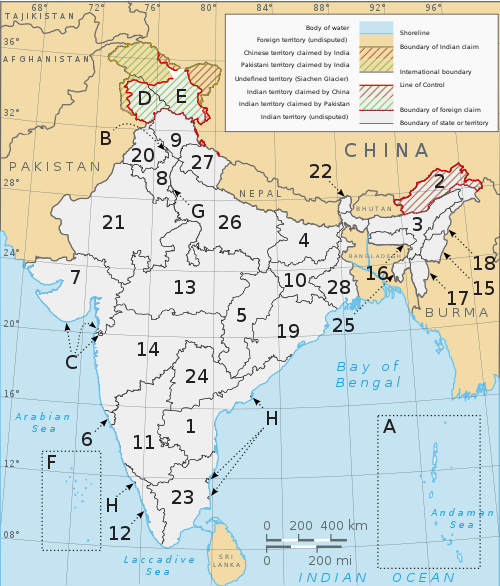

India is a federation composed of 28 states and 7 union territories.[171] All states, as well as the union territories of Puducherry and the National Capital Territory of Delhi, have elected legislatures and governments, both patterned on the Westminster model. The remaining five union territories are directly ruled by the centre through appointed administrators. In 1956, under the States Reorganisation Act, states were reorganised on a linguistic basis.[172] Since then, their structure has remained largely unchanged. Each state or union territory is further divided into administrative districts. The districts in turn are further divided into tehsils and ultimately into villages.
States
Union territories
Foreign relations and military

Since its independence in 1947, India has maintained cordial relations with most nations. In the 1950s, it strongly supported decolonisation in Africa and Asia and played a lead role in the Non-Aligned Movement.[173] In the late 1980s, the Indian military twice intervened abroad at the invitation of neighbouring countries: a peace-keeping operation in Sri Lanka between 1987 and 1990; and an armed intervention to prevent a coup d'état attempt in Maldives. India has tense relations with neighbouring Pakistan; the two nations have gone to war four times: in 1947, 1965, 1971, and 1999. Three of these wars were fought over the disputed territory of Kashmir, while the fourth, the 1971 war, followed from India's support for the independence of Bangladesh.[174] After waging the 1962 Sino-Indian War and the 1965 war with Pakistan, India pursued close military and economic ties with the Soviet Union; by the late 1960s, the Soviet Union was its largest arms supplier.[175]
Aside from ongoing strategic relations with Russia, India has wide-ranging defence relations with Israel and France. In recent years, it has played key roles in the South Asian Association for Regional Cooperation and the World Trade Organisation. The nation has provided 100,000 military and police personnel to serve in 35 UN peacekeeping operations across four continents. It participates in the East Asia Summit, the G8+5, and other multilateral forums.[176] India has close economic ties with South America, Asia, and Africa; it pursues a "Look East" policy that seeks to strengthen partnerships with the ASEAN nations, Japan, and South Korea that revolve around many issues, but especially those involving economic investment and regional security.[177][178]

China's nuclear test of 1964, as well as its repeated threats to intervene in support of Pakistan in the 1965 war, convinced India to develop nuclear weapons.[180] India conducted its first nuclear weapons test in 1974 and carried out further underground testing in 1998. Despite criticism and military sanctions, India has signed neither the Comprehensive Nuclear-Test-Ban Treaty nor the Nuclear Non-Proliferation Treaty, considering both to be flawed and discriminatory.[181] India maintains a "no first use" nuclear policy and is developing a nuclear triad capability as a part of its "minimum credible deterrence" doctrine.[182][183] It is developing a ballistic missile defence shield and, in collaboration with Russia, a fifth-generation fighter jet.[184] Other indigenous military projects involve the design and implementation of Vikrant-class aircraft carriers and Arihant-class nuclear submarines.[184]
Since the end of the Cold War, India has increased its economic, strategic, and military cooperation with the United States and the European Union.[185] In 2008, a civilian nuclear agreement was signed between India and the United States. Although India possessed nuclear weapons at the time and was not party to the Nuclear Non-Proliferation Treaty, it received waivers from the International Atomic Energy Agency and the Nuclear Suppliers Group, ending earlier restrictions on India's nuclear technology and commerce. As a consequence, India became the sixth de facto nuclear weapons state.[186] India subsequently signed cooperation agreements involving civilian nuclear energy with Russia,[187] France,[188] the United Kingdom,[189] and Canada.[190]
The President of India is the supreme commander of the nation's armed forces; with 1.6 million active troops, they compose the world's third-largest military.[191] It comprises the Indian Army, the Indian Navy, and the Indian Air Force; auxiliary organisations include the Strategic Forces Command and three paramilitary groups: the Assam Rifles, the Special Frontier Force, and the Indian Coast Guard.[8] The official Indian defence budget for 2011 was US$36.03 billion, or 1.83% of GDP.[192] For the fiscal year spanning 2012–2013, US$40.44 billion was budgeted.[193] According to a 2008 SIPRI report, India's annual military expenditure in terms of purchasing power stood at US$72.7 billion,[194] In 2011, the annual defence budget increased by 11.6%,[195] although this does not include funds that reach the military through other branches of government.[196] As of 2012, India is the world's largest arms importer; between 2007 and 2011, it accounted for 10% of funds spent on international arms purchases.[197] Much of the military expenditure was focused on defence against Pakistan and countering growing Chinese influence in the Indian Ocean.[195]
Economy

According to the World Bank, as of 2011, the Indian economy is nominally worth US$1.848 trillion;[12] it is the tenth-largest economy by market exchange rates, and is, at US$4.457 trillion, the third-largest by purchasing power parity, or PPP.[198] With its average annual GDP growth rate of 5.8% over the past two decades, and reaching 6.1% during 2011–12,[199] India is one of the world's fastest-growing economies.[200] However, the country ranks 140th in the world in nominal GDP per capita and 129th in GDP per capita at PPP.[198] Until 1991, all Indian governments followed protectionist policies that were influenced by socialist economics. Widespread state intervention and regulation largely walled the economy off from the outside world. An acute balance of payments crisis in 1991 forced the nation to liberalise its economy;[201] since then it has slowly moved towards a free-market system[202][203] by emphasising both foreign trade and direct investment inflows.[204] India's recent economic model is largely capitalist.[203] India has been a member of WTO since 1 January 1995.[205]
The 487.6-million worker Indian labour force is the world's second-largest, as of 2011.[8] The service sector makes up 55.6% of GDP, the industrial sector 26.3% and the agricultural sector 18.1%. Major agricultural products include rice, wheat, oilseed, cotton, jute, tea, sugarcane, and potatoes.[171] Major industries include textiles, telecommunications, chemicals, pharmaceuticals, biotechnology, food processing, steel, transport equipment, cement, mining, petroleum, machinery, and software.[171] In 2006, the share of external trade in India's GDP stood at 24%, up from 6% in 1985.[202] In 2008, India's share of world trade was 1.68%;[206] In 2011, India was the world's tenth-largest importer and the nineteenth-largest exporter.[207] Major exports include petroleum products, textile goods, jewellery, software, engineering goods, chemicals, and leather manufactures.[171] Major imports include crude oil, machinery, gems, fertiliser, and chemicals.[171] Between 2001 and 2011, the contribution of petrochemical and engineering goods to total exports grew from 14% to 42%.[208]

Averaging an economic growth rate of 7.5% for several years prior to 2007,[202] India has more than doubled its hourly wage rates during the first decade of the 21st century.[209] Some 431 million Indians have left poverty since 1985; India's middle classes are projected to number around 580 million by 2030.[210] Though ranking 51st in global competitiveness, India ranks 17th in financial market sophistication, 24th in the banking sector, 44th in business sophistication, and 39th in innovation, ahead of several advanced economies, as of 2010.[211] With 7 of the world's top 15 information technology outsourcing companies based in India, the country is viewed as the second-most favourable outsourcing destination after the United States, as of 2009.[212] India's consumer market, currently the world's eleventh-largest, is expected to become fifth-largest by 2030.[210]
India's telecommunication industry, the world's fastest-growing, added 227 million subscribers during the period 2010–11.[213] Its automotive industry, the world's second fastest growing, increased domestic sales by 26% during 2009–10,[214] and exports by 36% during 2008–09.[215] Power capacity is 250 gigawatts, of which 8% is renewable. The Pharmaceutical industry in India is among the significant emerging markets for global pharma industry. The Indian pharmaceutical market is expected to reach $48.5 billion by 2020. India's R & D spending constitutes 60% of Biopharmaceutical industry.[216][217] India is among the top 12 Biotech destinations of the world.[218] [219] At the end of 2011, Indian IT Industry employed 2.8 million professionals, generated revenues close to US$100 billion equaling 7.5% of Indian GDP and contributed 26% of India's merchandise exports.[220]

Despite impressive economic growth during recent decades, India continues to face socio-economic challenges. India contains the largest concentration of people living below the World Bank's international poverty line of US$1.25 per day,[221] the proportion having decreased from 60% in 1981 to 42% in 2005.[222] Half of the children in India are underweight,[223] and 46% of children under the age of three suffer from malnutrition.[221] The Mid-Day Meal Scheme attempts to lower these rates.[224] Since 1991, economic inequality between India's states has consistently grown: the per-capita net state domestic product of the richest states in 2007 was 3.2 times that of the poorest.[225] Corruption in India is perceived to have increased significantly,[226] with one report estimating the illegal capital flows since independence to be US$462 billion.[227] Driven by growth, India's nominal GDP per capita has steadily increased from US$329 in 1991, when economic liberalisation began, to US$1,265 in 2010, and is estimated to increase to US$2,110 by 2016; however, it has always remained lower than those of other Asian developing countries such as Indonesia, Iran, Malaysia, Philippines, Sri Lanka, and Thailand, and is expected to remain so in the near future.[228]
According to a 2011 PricewaterhouseCoopers report, India's GDP at purchasing power parity could overtake that of the United States by 2045.[229] During the next four decades, Indian GDP is expected to grow at an annualised average of 8%, making it potentially the world's fastest-growing major economy until 2050.[229] The report highlights key growth factors: a young and rapidly growing working-age population; growth in the manufacturing sector because of rising education and engineering skill levels; and sustained growth of the consumer market driven by a rapidly growing middle class.[229] The World Bank cautions that, for India to achieve its economic potential, it must continue to focus on public sector reform, transport infrastructure, agricultural and rural development, removal of labour regulations, education, energy security, and public health and nutrition.[230]
Citing persistent inflation pressures, weak public finances, limited progress on fiscal consolidation and ineffectiveness of the government, rating agency Fitch revised India's Outlook to Negative from Stable on 18 June 2012.[231] Another credit rating agency S&P had warned previously that a slowing GDP growth and political roadblocks to economic policy-making could put India at the risk of losing its investment grade rating.[232] However, Moody didn't revise its outlook on India keeping it stable,[233] but termed the national government as the "single biggest drag" on the business activity.[234]
Demographics

With 1,210,193,422 residents reported in the 2011 provisional census,[5] India is the world's second-most populous country. Its population grew at 1.76% per annum during 2001–2011,[5] down from 2.13% per annum in the previous decade (1991–2001).[235] The human sex ratio, according to the 2011 census, is 940 females per 1,000 males.[5] The median age was 24.9 in the 2001 census.[8] The first post-colonial census, conducted in 1951, counted 361.1 million people.[236] Medical advances made in the last 50 years as well as increased agricultural productivity brought about by the "Green Revolution" have caused India's population to grow rapidly.[237] India continues to face several public health-related challenges.[238][239] According to the World Health Organisation, 900,000 Indians die each year from drinking contaminated water or breathing polluted air.[240] There are around 50 physicians per 100,000 Indians.[241] The number of Indians living in urban areas has grown by 31.2% between 1991 and 2001.[242] Yet, in 2001, over 70% lived in rural areas.[243][244] According to the 2001 census, there are 27 million-plus cities in India;[242] among them Delhi, Mumbai, Kolkata, Chennai, Bangalore, Hyderabad and Ahmedabad are the most populous metropolitan areas. The literacy rate in 2011 was 74.04%: 65.46% among females and 82.14% among males.[5] Kerala is the most literate state;[245] Bihar the least.[246]
India is home to two major language families: Indo-Aryan (spoken by about 74% of the population) and Dravidian (24%). Other languages spoken in India come from the Austroasiatic and Tibeto-Burman language families. India has no national language.[247] Hindi, with the largest number of speakers, is the official language of the government.[248][249] English is used extensively in business and administration and has the status of a "subsidiary official language";[250] it is important in education, especially as a medium of higher education. Each state and union territory has one or more official languages, and the constitution recognises in particular 21 "scheduled languages". The Constitution of India recognises 212 scheduled tribal groups which together constitute about 7.5% of the country's population.[251] The 2001 census reported that Hinduism, with over 800 million adherents (80.5% of the population), was the largest religion in India; it is followed by Islam (13.4%), Christianity (2.3%), Sikhism (1.9%), Buddhism (0.8%), Jainism (0.4%), Judaism, Zoroastrianism, and the Bahá'í Faith.[252] India has the world's largest Hindu, Sikh, Jain, Zoroastrian, and Bahá'í populations, and has the third-largest Muslim population and the largest Muslim population for a non-Muslim majority country.[253][254]
Culture

Indian cultural history spans more than 4,500 years.[255] During the Vedic period (c. 1700–500 BCE), the foundations of Hindu philosophy, mythology, and literature were laid, and many beliefs and practices which still exist today, such as dhárma, kárma, yóga, and mok?a, were established.[14] India is notable for its religious diversity, with Hinduism, Sikhism, Islam, Christianity, and Jainism among the nation's major religions.[256] The predominant religion, Hinduism, has been shaped by various historical schools of thought, including those of the Upanishads,[257] the Yoga Sutras, the Bhakti movement,[256] and by Buddhist philosophy.[258]
Art and architecture
Much of Indian architecture, including the Taj Mahal, other works of Mughal architecture, and South Indian architecture, blends ancient local traditions with imported styles.[259] Vernacular architecture is also highly regional in it flavours. Vastu shastra, literally "science of construction" or "architecture" and
RONALDO
Ronaldo Luís Nazário de Lima (locally: [?o?nawðu ?lwi? n??za?ju d? ???m?]; born 18 September 1976[1]) commonly known as Ronaldo, is a retired Brazilian footballer. Popularly dubbed "the phenomenon", he is considered by experts and fans as one of the greatest football players of all time.[2][3] In 2011, he was voted Goal.com's "Player of the Decades" in an online poll of the Spanish version of the website, gathering 29.55% of all votes.[4] He won his first Ballon d'Or as the European Footballer of the Year in 1997 and won the award again in 2002. He is one of only three men to have won the FIFA Player of the Year award three times, along with Zinedine Zidane and Lionel Messi.
Considered by many as the most complete striker in the past 30 years, in 2007, he was named as one of the best starting 11 of all-time by France Football and was named to the FIFA 100, a list of the greatest footballers compiled by Pelé. In 2010, he was voted Goal.com's "Player of the Decade" in an online poll, gathering 43.63 percent of all votes[5] and was also included as centre forward in the "Team of the Decade".[6] On 23 February 2010, Ronaldo announced that he would retire after the 2011 season, signing a two-year contract extension with the Corinthians at the same time.[7]
Ronaldo has played for Brazil in 98 international matches, scoring 62 goals. He was a part of the Brazilian squad that won the 1994 and 2002 World Cups. During the 2006 FIFA World Cup, Ronaldo became the highest goalscorer in the history of the World Cup with his fifteenth goal, surpassing Gerd Müller's previous record of 14. He is the only player to have won the World Cup Golden Ball and Golden Boot in separate tournaments. Having suffered a string of serious injuries throughout his career, Ronaldo retired on 14 February 2011, citing pain and hypothyroidism as the reasons for his premature retirement.[8]