Welcome to Smartindia Student's Blog
snow cat]


A snowcat is an enclosed-cab, truck-sized, fully tracked vehicle designed to move on snow. Snowcats are often referred to as 'trail groomers' (or 'piste bashers' in British English) because of their use for grooming ski trails ("pistes") or snowmobile trails. Most snowcats, such as the ones produced byBombardier or Aktiv in the past, have two sets of tracks, fitted with a Christie suspension or a Vickers suspension. Others, like the Tucker Sno-Cat andHägglunds vehicles, have a complex arrangement of four or more tracks.
The tracks are usually made of rubber, aluminum or steel and driven by a single sprocket on each side, and ride over rubber wheels with a solid foam interior. Their design is optimized for a snow surface, or soft grounds such as that of a peat bog. In addition to grooming snow they are used for polar expeditions, logging in marsh areas, leveling sugar beet piles, and seismic studies in the wild.
The cabs are optimized for use in sub-zero weather or cold conditions worsened by wind chill, with strong forced heating and a windshield designed to be kept clear of internal and external ice or condensation through a variety of means such as advanced coatings, external scrapers (windshield wipers of a modified type), and internal ducts blowing hot air on the surface.
Contents[hide] |
snow bear
| Tibetan blue bear | |
|---|---|
 | |
| U. a. pruinosus | |
| Conservation status | |
Scientific classification | |
| Kingdom: | Animalia |
| Phylum: | Chordata |
| Class: | Mammalia |
| Order: | Carnivora |
| Family: | Ursidae |
| Genus: | Ursus |
| Species: | U. arctos |
| Subspecies: | U. a. pruinosus |
| Trinomial name | |
| Ursus arctos pruinosus Blyth, 1854 | |
snow dog
 Promotional poster. | |
| Directed by | Brian Levant |
|---|---|
| Produced by | Casey Grant Jordan Kerner |
| Written by | Jim Kouf Tommy Swerdlow Michael Goldberg Mark Gibson Philip Halprin |
| Based on | Premise suggested byWinterdance: The Fine Madness of Running the Iditarod by Gary Paulsen |
| Starring | Cuba Gooding Jr. James Coburn Nichelle Nichols Joanna Bacalso Sisqó |
| Music by | John Debney |
| Cinematography | Thomas E. Ackerman |
| Editing by | Roger Bondelli |
| Studio | Kerner Entertainment |
| Distributed by | Walt Disney Pictures |
| Release date(s) |
|
| Running time | 101 minutes |
| Country | United States |
| Language | English |
| Budget | $33 million |
| Box office | $115,035,090 |
tailor bird
| Tailorbird | |
|---|---|
 | |
| Common Tailorbirds (Orthotomus sutorius) | |
| Scientific classification | |
| Kingdom: | Animalia |
| Phylum: | Chordata |
| Class: | Aves |
| Order: | Passeriformes |
| Family: | Cisticolidae |
| Genus: | Orthotomus Horsfield, 1821 |
| Species | |
See text | |
cheetah

| Cheetah[1] Temporal range: Late Pliocene to Recent | |
|---|---|
 | |
| Conservation status | |
| Scientific classification | |
| Kingdom: | Animalia |
| Phylum: | Chordata |
| Class: | Mammalia |
| Order: | Carnivora |
| Family: | Felidae |
| Genus: | Acinonyx |
| Species: | A. jubatus |
| Binomial name | |
| Acinonyx jubatus (Schreber, 1775) | |
| Type species | |
| Acinonyx venator Brookes, 1828 (= Felis jubata, Schreber, 1775) by monotypy | |
| Subspecies | |
See text. | |
 | |
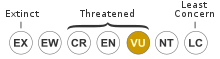
leopard
| ard | |
|---|---|
 | |
| Female Indian leopard from Bardia National Park, Nepal | |
| Conservation status | |
| Scientific classification | |
| Kingdom: | Animalia |
| Phylum: | Chordata |
| Class: | Mammalia |
| Order: | Carnivora |
| Family: | Felidae |
| Genus: | Panthera |
| Species: | P. pardus |
| Subspecies: | P. p. fusca |
| Trinomial name | |
| Panthera pardus fusca (Meyer), 1794 | |
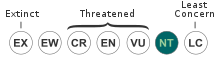
The Indian leopard (Panthera pardus fusca) is a leopard subspecies widely distributed on the Indian subcontinent and classified as Near Threatened
horse

| Domestic horse | |
|---|---|
 | |
| Conservation status | |
Domesticated | |
| Scientific classification | |
| Kingdom: | Animalia |
| Phylum: | Chordata |
| Class: | Mammalia |
| Subclass: | Theria |
| Infraclass: | Eutheria |
| Order: | Perissodactyla |
| Family: | Equidae |
| Genus: | Equus |
| Species: | E. ferus |
| Subspecies: | E. f. caballus |
| Trinomial name | |
| Equus ferus caballus Linnaeus, 1758[1] | |
| Synonyms | |
48[2] | |
seahorse
| Seahorses Temporal range: 23–0Ma Lower Miocene to Present | |
|---|---|
 | |
| Hippocampus sp. | |
| Scientific classification | |
| Kingdom: | Animalia |
| Phylum: | Chordata |
| Class: | Actinopterygii |
| Order: | Syngnathiformes |
| Family: | Syngnathidae |
| Subfamily: | Hippocampinae |
| Genus: | Hippocampus Rafinesque, 1810[1] |
| Species | |
see Species. | |
Seahorse is the title given to 54 species of marine fish in the genus Hippocampus. "Hippocampus" comes from the Ancient Greek hippos meaning "horse" and kampos meaning "sea monster".[2]
Contents[hide] |
Location [edit]
Seahorses are mainly found in shallow tropical and temperate waters throughout the world, and prefer to live in sheltered areas such as seagrass beds,estuaries, coral reefs, or mangroves. In Pacific waters from North America to South America there are approximately four species. In the Atlantic, the H. erectus ranges from Nova Scotia to Uruguay. H. zosterae, known as the dwarf seahorse, is found in the Bahamas.
Colonies have been found in European waters such as the Thames Estuary.[3]
Three species live in the Mediterranean Sea: H. guttulatus (the long-snouted seahorse), H. hippocampus (the short-snouted seahorse) and H. fuscus(the sea pony). These species form territories; males stay within 1 square meter (11 sq ft) of their habitat while females range about one hundred times that.
Physical description [edit]
.jpg)
dinousaurs
| Dinosaurs Temporal range: Middle Triassic–Present, 231.4–0 Ma (range includes birds) | |
|---|---|
 | |
| A collection of fossil dinosaur skeletons. Clockwise from top left: Microraptor gui (a winged theropod), Apatosaurus louisae (a giant sauropod), Stegosaurus stenops (a platedstegosaur), Triceratops horridus (a horned ceratopsian),Edmontosaurus regalis (a duck-billed ornithopod),Gastonia burgei (an armored ankylosaur). | |
| Scientific classification | |
| Kingdom: | Animalia |
| Phylum: | Chordata |
| Class: | Reptilia |
| Clade: | Dinosauriformes |
| Clade: | Dinosauria Owen, 1842 |
| Major groups | |
Dinosaurs are a diverse group of animals of the clade Dinosauria. They first appeared during the Triassic period, approximately 230 million
victoria falls
| Victoria Falls | |
|---|---|
 Victoria Falls | |
| Location | Livingstone, Zambia Victoria Falls, Zimbabwe |
| Coordinates | 17°55?28?S 25°51?24?ECoordinates: 17°55?28?S 25°51?24?E |
| Type | Waterfall |
| Total height | 355 ft (108 m) (at center) |
| Number of drops | 1 |
| Watercourse | Zambezi River |
| Average flow rate | 1088 m³/s (38,430 cu ft/s) |
| Official name: Mosi-oa-Tunya / Victoria Falls | |
| Type: | Natural |
| Criteria: | vii, viii |
| Designated: | 1989 (13th session) |
| Reference No. | 509 |
| State Party: | Zambia and Zimbabwe |
| Region: | Africa |

victoria falls
| Victoria Falls | |
|---|---|
Victoria Falls | |
| Location | Livingstone, Zambia Victoria Falls, Zimbabwe |
| Coordinates | 17°55?28?S 25°51?24?ECoordinates: 17°55?28?S 25°51?24?E |
| Type | Waterfall |
| Total height | 355 ft (108 m) (at center) |
| Number of drops | 1 |
| Watercourse | Zambezi River |
| Average flow rate | 1088 m³/s (38,430 cu ft/s) |
| Official name: Mosi-oa-Tunya / Victoria Falls | |
| Type: | Natural |
| Criteria: | vii, viii |
| Designated: | 1989 (13th session) |
| Reference No. | 509 |
| State Party: | Zambia and Zimbabwe |
| Region: | Africa |
jog falls
| Jog Falls | |
|---|---|
 Jog Falls during monsoon | |
  | |
| Location | Uttara Kannada, India |
| Coordinates | 14°13?44?N 74°48?43?ECoordinates: 14°13?44?N 74°48?43?E |
| Type | Cataract, segmented |
| Elevation | 488 metres (1600 ft MSL) |
| Total height | 253 meters (829 feet) |
| Number of drops | 1 |
| Longest drop | 253 meters (829 feet) |
| Watercourse | Sharavathi River |
| Average flow rate | 153 m³/s or 5,387 cu ft/s |